
Concentric vs. Eccentric Butterfly Valve: Which Suits HVAC and Water Systems?
What Is a Concentric (Zero-Offset) Butterfly Valve?
In a concentric design, the stem axis passes through the centre of the disc, and the disc is centred in the bore. The disc seals by interfering with a resilient seat — typically EPDM, NBR or PTFE — so the sealing force is applied symmetrically around the full circumference. The result is the simplest, lightest and most economical butterfly valve: a compact face-to-face dimension, low pressure drop and low operating torque at moderate duty.
The trade-off is friction. The disc edge stays in contact with the seat through most of its stroke, so the seat rubs on every cycle. That wear mechanism caps both cycle life and the pressure-temperature envelope: elastomer seats typically top out around 90–120 °C, and Class 125/150 ratings are the industry norm.
Athena's concentric butterfly valves cover 2″–48″, Class 125–150, in wafer, lug and flanged ends, with cast iron, carbon steel, stainless steel or bronze bodies and ISO 5211 actuator interfaces. A fully rubber-covered body option isolates the housing from the medium, extending service life in corrosive duty.
What Is an Eccentric (Double-Offset) Butterfly Valve?
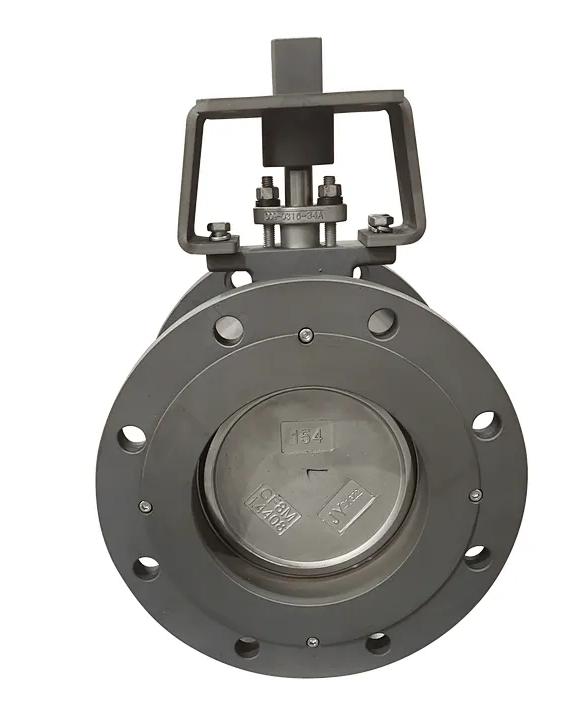
A double-offset design displaces the stem twice: behind the disc sealing plane, and off the pipe centreline. The disc therefore cams away from the seat within the first few degrees of opening and re-engages only near final closure. Rubbing is reduced to a fraction of the stroke, cutting both torque and seat wear — and making it possible to use harder seats (reinforced PTFE, metal or laminated constructions) at higher pressure and temperature.
In the trade, double-offset valves are commonly marketed as "high-performance butterfly valves". Adding a third, conical offset produces the triple-offset, metal-to-metal design used for steam and severe service. Athena's double-offset valves span 1-1/2″–80″ and Class 150–2500 with bi-directional zero-leakage sealing, while the triple-offset range covers the same envelope with metal seats for arduous duty.
Concentric vs. Eccentric: Key Differences at a Glance
The single most useful way to compare the two families is to look at how the disc meets the seat, because every downstream difference — torque, wear, temperature ceiling, cost — follows from that geometry.
| Aspect | Concentric (zero-offset) | Eccentric (double-offset) |
| Geometry | Stem, disc and bore share one axis | Stem offset behind the disc and off the bore centreline |
| Seat action | Disc rubs the seat through most of the stroke | Disc cams off the seat; contact only near closure |
| Seat materials | EPDM, NBR, PTFE liners | RPTFE, metal and laminated seats |
| Typical rating | Class 125–150 | Class 150 up to 2500 |
| Athena size range | 2″–48″ | 1-1/2″–80″ |
| Temperature ceiling | ~90–120 °C with elastomer; higher with PTFE liner | Substantially higher; metal seats for steam |
| Throttling | Light, occasional modulation | Frequent modulation with minimal wear |
| Relative cost | Lower | Higher |
| Best duty | Clean water, air, HVAC, plant utilities | Process, chemical, higher P/T, high-cycle service |
Where Concentric Valves Win: Water, HVAC and Utility Duty
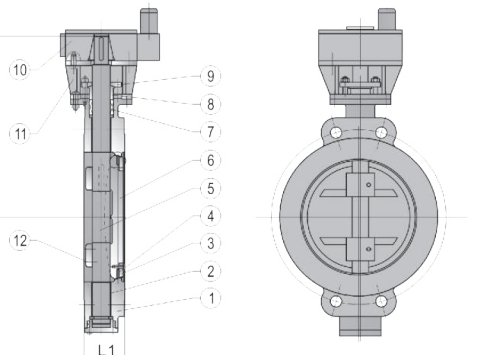
For chilled and heating water, glycol loops, compressed air, domestic water and general plant utilities, a concentric valve is usually the correct engineering choice — provided the service stays inside the seat's rating. It delivers bidirectional symmetrical sealing, low torque that suits lever or small actuator operation, and the lowest cost per diameter. Athena's concentric range adds practical advantages for project work: a bi-directional sealing function, a rubber fully covered body that keeps the medium away from the housing, and ISO 5211 mounting for straightforward actuator retrofits.
Where Eccentric Valves Earn Their Cost
Step up to an eccentric design when any of the following applies:
- High cycle frequency, where seat rubbing would shorten service life
- Pressure or temperature beyond the soft-seat envelope
- Abrasive, corrosive or viscous media
- Tighter shutoff classes than a resilient seat can hold
- Steam, hydrocarbon or other severe service — here a triple-offset metal-seat valve is the standard answer
The premium is justified by the duty, not by the nameplate: as discussed in our guide to butterfly valve classifications, the seat — not the body — sets the real operating envelope.
How to Choose: A Practical Selection Checklist
1.Define the medium, including corrosivity and solids content.
2.Fix design pressure and temperature, then check the seat rating first — the seat, not the body, sets the ceiling.
3.Estimate cycle frequency over the valve's life.
4.Decide whether the duty is isolation or continuous modulation.
5.Confirm the required leakage class and whether sealing must work in both directions.
6.Match end connections and the actuator interface (ISO 5211).
7.Specify documentation up front: EN 10204 3.1 material test certificates, hydrostatic test reports and third-party inspection.
Why Source from Athena
Athena manufactures concentric butterfly valves to API 609 in sizes from 2″ to 48″, Class 125–150, with wafer, lug and flanged ends and lever, gear, motor or pneumatic operation. Every valve is built from genuine, guaranteed raw material and supplied with material test certificates (EN 10204 3.1) and hydraulic test certificates; third-party inspection agencies are welcome. Complete material and test documentation is provided for every batch — simplifying spare-parts management and procurement sign-off for overseas EPC projects.
FAQ
Is a concentric butterfly valve the same as a resilient-seated butterfly valve?
In practice, yes. "Concentric", "zero-offset" and "resilient-seated" all describe the same geometry: a centred stem and disc sealing against an elastomer or PTFE seat.
Can a concentric butterfly valve be used for throttling?
Light, occasional modulation is acceptable. Continuous throttling accelerates seat wear and raises torque; for that duty, specify a double-offset valve.
What temperature can a concentric butterfly valve handle?
It depends on the seat: EPDM and NBR seats typically serve up to roughly 90–120 °C, while PTFE-lined seats reach further. Always verify against the specific datasheet rather than the generic class rating.
Is a concentric butterfly valve suitable for steam?
Generally no — soft-seat construction limits both temperature and fire-safe capability. For steam and severe service, specify an eccentric or triple-offset metal-seat valve.
What documentation comes with Athena valves?
EN 10204 3.1 material test certificates, hydraulic test reports, and support for third-party inspection, supplied batch by batch.
 Slurry Knife Gate Valve
 2026 Ranking of the World’s Top 10 Ball Valve Brands
 How to Select Part‑Turn, Linear‑Stroke and Multi‑Turn Electric Actuators
 How to Fix a Leaking Ball Valve
 How to Repair a Gate Valve
 Pressure Seal Type Gate Valve for High-Pressure High-Temperature Industrial Isolation
 What Are the Differences Between Forged Valves and Cast Valves?
 Characteristics, Applications and Advantages of Carbon Steel Globe Valves
 Why Are Instrument Valves Indispensable for Industrial Control Systems?
 What is Bi-Directional Valves?
 How Does a Ball Type Check Valve Prevent Pipeline Medium Backflow?
 Selection and Precautions for Natural Gas Valves
 Athena Engineering S.R.L Wraps‑up OGA 2026 Kuala Lumpur
 What is a Gate Valve? What is Its Working Principle?
 T-Type / T-Pattern / Straight Pattern Globe Valve
 Knife Gate Valve vs Wedge Gate Valve: Which Is Better for Your Industrial Piping?
 Cryogenic Ball Valve Comprehensive Product Overview
 Causes and Treatments for Poor Valve Shut‑Off
 Athena Triple Offset Butterfly Valves
 What is the Difference Between Swing Check Valve and NRV? A Complete Explanation