
What Are the Differences Between Forged Valves and Cast Valves?
author: ATHENA GROUP
2026-10-09
I. What is a Cast Valve Body?
Casting is one of mankind’s oldest metal hot‑working processes with simple and mature process logic: metal is heated to high temperature and melted into liquid, poured into a custom mould cavity, and allowed to cool and solidify naturally to form a valve body blank consistent with the mould. After demoulding, burr removal, and finish‑machining of key parts such as sealing surfaces, a finished cast valve body is obtained.
The biggest advantage of casting lies in its powerful forming capacity and high cost‑effectiveness for mass production. Molten metal can fully fill all gaps of the mould, easily producing valve bodies with complex inner cavities, curved flow passages, special‑shaped structures and large nominal diameters — an irreplaceable advantage that forging cannot offer. When production reaches batch scale, casting shows obvious cost advantages. Therefore, cast valves serve as standard equipment for water treatment plants, HVAC systems, irrigation pipe networks and ordinary industrial pipelines, delivering stable, practical and economical performance under conventional low‑pressure working conditions.
Nevertheless, the casting process has inherent drawbacks. Uneven cooling of metal inside the mould will generate invisible micropores, bubbles and shrinkage defects within the valve body. Meanwhile, metal grains in castings are disorderly arranged and loosely distributed, resulting in low tensile strength and yield strength. Under working conditions of high temperature, high pressure or repeated thermal cycles, these hidden defects will gradually expand and cause failures such as leakage and fatigue cracking, making cast valves unsuitable for long‑term operation under harsh working conditions.
II. What is a Forged Valve Body?
The forged valve body adopts a completely different solid‑state forming process without melting metal. In production, solid metal billets are used as raw materials, heated to a plastic state, and then repeatedly hammered and extruded by forging equipment to produce plastic deformation of metal for the final formation of valve body structures.
The core advantage of forging is the optimized internal grain structure of metal. The forging process compacts porosity and voids in raw materials, stretching and aligning grains in an orderly orientation, which greatly improves overall compactness, crack resistance and anti‑fatigue performance.
In addition, forged valve bodies can achieve thinner wall thickness under the same pressure rating. Thin‑walled structures realize more uniform heat absorption and heat dissipation and reduce thermal‑fatigue damage effectively. They are especially suitable for working conditions with frequent start‑stop operations and drastic temperature‑pressure fluctuations such as power plants and steam pipelines, with far superior operational stability compared with cast valve bodies.
Forging also has distinct disadvantages: long production cycles, high mould costs and high manufacturing costs. Restricted by solid‑state forging, it cannot produce structures with complex inner cavities or special‑shaped profiles and is only applicable to valve bodies with simple structures and small nominal diameters.
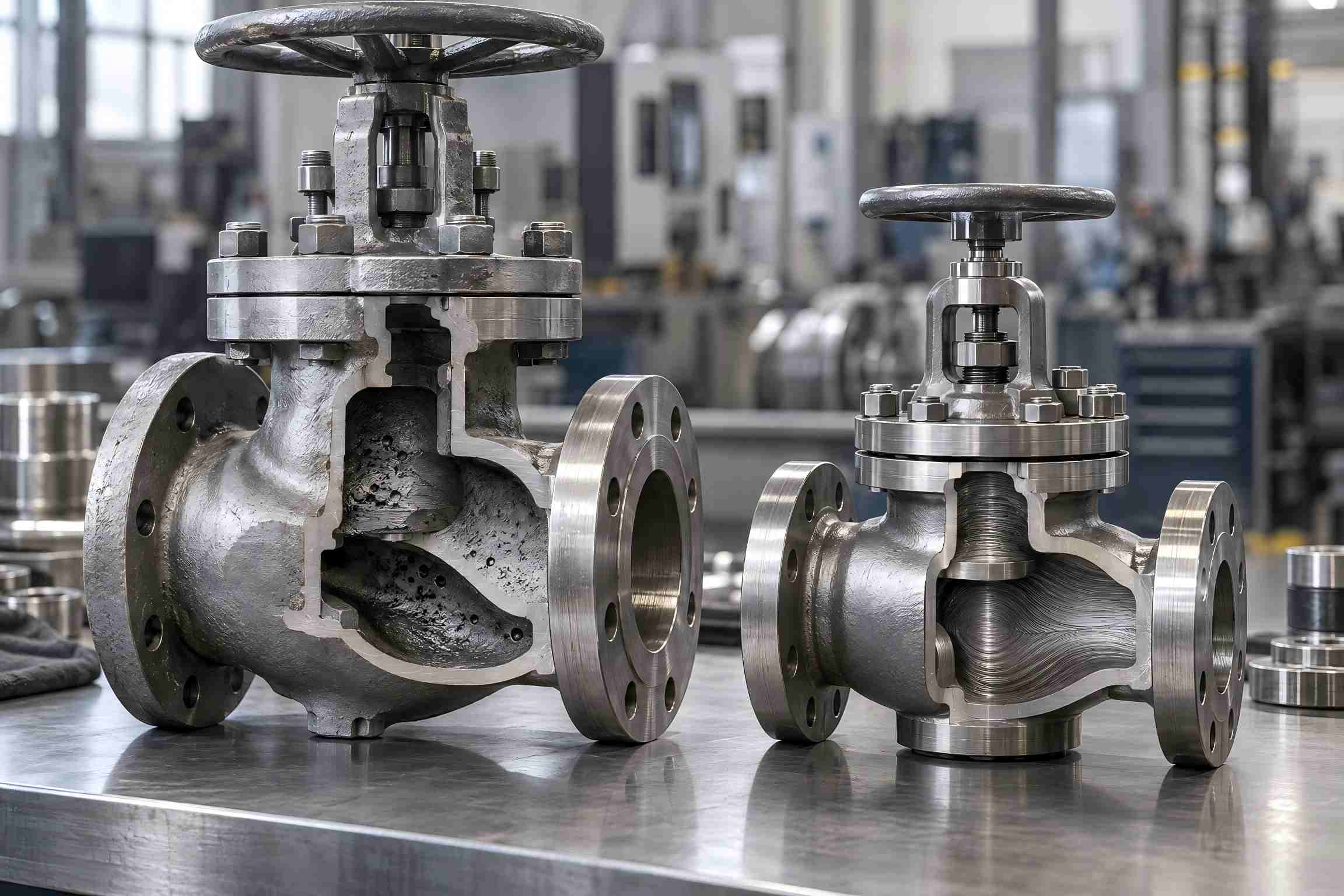
III. Core Comparative Differences Between Cast Valves and Forged Valves
1. Differences in Structure and Dimension
Cast valves can realize large nominal diameters, complex flow passages and special‑shaped inner‑cavity structures with few limitations in shape, compatible with most general‑purpose pipelines. Forged valves are only applicable to valve bodies of DN50 and below with simple and regular structures and cannot form complex internal passages.
2. Differences in Mechanical Properties
Cast valve bodies feature loose and disorderly grains with internal micropore defects, poor toughness, impact resistance and fatigue resistance, and are prone to failures under large pressure fluctuations. Forged valve bodies possess dense and orderly grains free of porosity defects, with comprehensively superior strength, toughness, sealing performance and thermal‑fatigue resistance, as well as stronger pressure‑bearing capacity and operational safety stability.
3. Differences in Applicable Working Conditions
Cast valves: Suitable for conventional working conditions of normal temperature, normal pressure and stable media, mostly used in civil and general‑industrial scenarios such as water supply‑drainage, HVAC, irrigation and ordinary low‑pressure chemical pipelines.
Forged valves: Suitable for harsh working conditions of high temperature, high pressure, frequent start‑stop cycles and flammable‑explosive media, widely applied in thermal power generation, high‑pressure oil‑gas transportation, fine chemicals and core pipelines of high‑end industries.
4. Differences in Cost and Service Life
Cast valves feature simple processes and support mass production with low procurement costs and high cost‑effectiveness, yet they have shorter service life and require more frequent maintenance and inspection in later stages. Forged valves involve complex manufacturing processes and high costs, but deliver stable performance, extremely low failure rates, and a service life 2‑3 times that of cast valves, bringing lower comprehensive long‑term operating costs.
IV. Valve Selection Guidelines
There exists a common misconception that forged valves are absolutely superior to cast valves. In fact, neither is inherently better than the other; suitability for working conditions matters most. For large‑nominal‑diameter pipelines under conventional low‑pressure conditions in civil and general‑industrial applications, cast valves are preferred to balance cost and practicality. For small‑nominal‑diameter core pipelines operating under high‑temperature, high‑pressure and continuous‑running conditions with stringent safety requirements, forged valves must be adopted to eliminate potential safety hazards.
V. Summary
Simply put, cast valves excel in high cost‑effectiveness, complex structures and general‑purpose working conditions with large nominal diameters, meeting most conventional industrial demands yet subject to inherent performance limitations imposed by manufacturing processes. Forged valves feature high density, high strength and high safety for various extreme and harsh working conditions, yet come with simple structural forms and higher costs.
Athenavalve has deep expertise in the R&D and manufacturing of industrial valves for years. We can accurately match high‑quality cast valves and forged valves according to project‑specific requirements for pressure, temperature, media and pipe diameter. Should you have questions on valve selection, customization needs or procurement plans, feel free to send us inquiries. We will provide you with professional one‑stop solutions for piping valves and accurate quotations.
 Characteristics, Applications and Advantages of Carbon Steel Globe Valves
  Why Are Instrument Valves Indispensable for Industrial Control Systems?
  What is Bi-Directional Valves?
  How Does a Ball Type Check Valve Prevent Pipeline Medium Backflow?
  Selection and Precautions for Natural Gas Valves
  Athena Engineering S.R.L Wraps‑up OGA 2026 Kuala Lumpur
  What is a Gate Valve? What is Its Working Principle?
  T-Type / T-Pattern / Straight Pattern Globe Valve
  Knife Gate Valve vs Wedge Gate Valve: Which Is Better for Your Industrial Piping?
  Cryogenic Ball Valve Comprehensive Product Overview
  Causes and Treatments for Poor Valve Shut‑Off
  Athena Triple Offset Butterfly Valves
  What is the Difference Between Swing Check Valve and NRV? A Complete Explanation
  Common Connection Types of Valves
  5 Piping Design Mistakes That Are Killing Your Valves
  Float Valve: Structure, Principle and Application
  High Pressure Needle Valve High-Precision Fluid Control Valve
  What is a Piston Check Valve?
  Meet Us at OGA 2026 | Booth 6802, Hall 6
  What is a Level Gauge? Working Principles, Types and Industrial Applications