
What RTJ Means in a Check Valve
author: ATHENA GROUP
2026-11-12

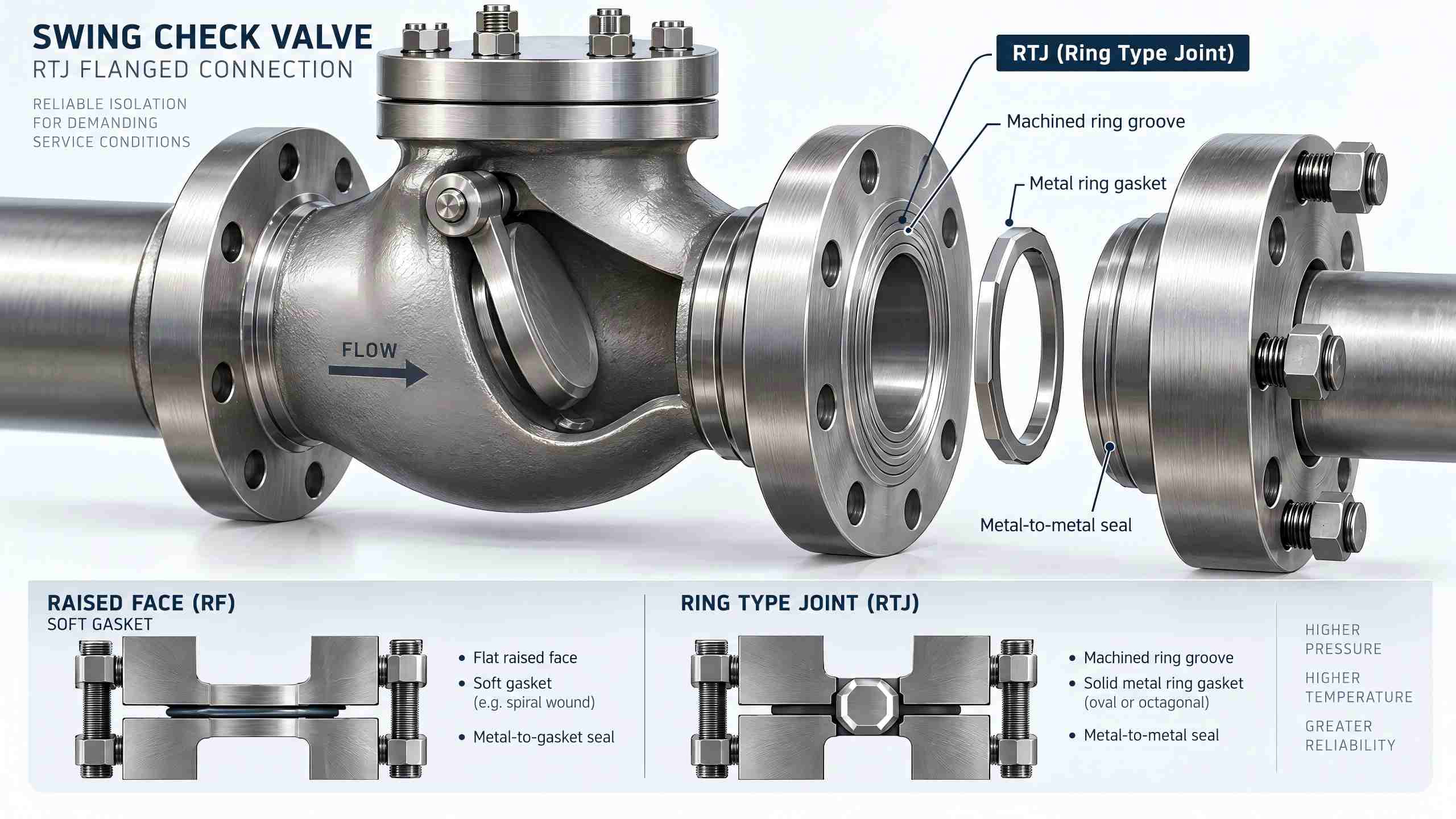
Athenavalve frequently receives technical inquiries from global partners about flange abbreviations, and one of the most common questions is what RTJ specifically refers to in a check valve. If you browse RTJ flanged check valve datasheets, flange drawings, or API specifications, you will often encounter the abbreviation RTJ. RTJ stands for Ring Type Joint, widely known as the ring type joint flange face.
How the RTJ Seal Works
Unlike ordinary raised-face flanges, RTJ flanges have a precision-machined circular groove in the sealing surface. A solid metal ring gasket sits in this groove. When bolt torque is applied, the metal gasket deforms slightly, forming a tight metal-to-metal seal.
Where RTJ Flanged Check Valves Are Used
This sealing design is not universal to all check valves. It is specifically used for high-pressure, high-temperature, hydrogen service, and critical pipelines in oil and gas, petrochemical, refining, and offshore projects. Standards including ASME B16.5 and API 6D cover RTJ flanged check valves.
Gasket Types and Performance Advantages
RTJ gaskets come in several types. R-type rings are conventional, while RX and BX rings are designed for ultra-high-pressure service. Compared with RF flanges that rely mainly on soft gaskets, RTJ connections provide stronger resistance to gasket blowout, thermal cycling, and fluid erosion.
Reading RTJ in Specifications
In procurement and technical communication, you will often see descriptions such as "swing check valve, RTJ flange, Class 1500." It simply tells engineers that the RTJ flanged check valve is equipped with ring type joint flanges to match the RTJ face of the pipeline.
What RTJ Does Not Change
It is worth noting that RTJ only defines the flange sealing face. It does not change the internal structure of the check valve. Swing check valves, lift check valves, dual plate check valves, and tilting disc check valves can be supplied upon request.
When to Choose an RTJ Check Valve
When should you choose an RTJ check valve? When your pipeline operates above medium pressure and medium temperature thresholds and requires RTJ, and you must ensure reliable zero leakage. For low-pressure water, air, or general utility lines, RF flanges remain the more economical choice.
Installation Warning: Avoid Face Mismatch
Correctly identifying RTJ helps avoid flange face mismatch during installation. Mismatched RF and RTJ faces can never achieve a reliable seal and may lead to dangerous leaks and failure.
Sourcing RTJ Flanged Check Valves
Whether you are purchasing swing valves, dual plate valves, or lift check valves with RTJ flanges, Athenavalve provides fully compliant, precision-manufactured RTJ flanged check valves to ensure long-term sealing performance in critical process piping.
 Valve Pickling Methods
 Concentric vs. Eccentric Butterfly Valve: Which Suits HVAC and Water Systems?
 Slurry Knife Gate Valve
 2026 Ranking of the World’s Top 10 Ball Valve Brands
 How to Select Part‑Turn, Linear‑Stroke and Multi‑Turn Electric Actuators
 How to Fix a Leaking Ball Valve
 How to Repair a Gate Valve
 Pressure Seal Type Gate Valve for High-Pressure High-Temperature Industrial Isolation
 What Are the Differences Between Forged Valves and Cast Valves?
 Characteristics, Applications and Advantages of Carbon Steel Globe Valves
 Why Are Instrument Valves Indispensable for Industrial Control Systems?
 What is Bi-Directional Valves?
 How Does a Ball Type Check Valve Prevent Pipeline Medium Backflow?
 Selection and Precautions for Natural Gas Valves
 Athena Engineering S.R.L Wraps‑up OGA 2026 Kuala Lumpur
 What is a Gate Valve? What is Its Working Principle?
 T-Type / T-Pattern / Straight Pattern Globe Valve
 Knife Gate Valve vs Wedge Gate Valve: Which Is Better for Your Industrial Piping?
 Cryogenic Ball Valve Comprehensive Product Overview
 Causes and Treatments for Poor Valve Shut‑Off