
Why Are Instrument Valves Indispensable for Industrial Control Systems?
author: ATHENA GROUP
2026-09-23

Instrument valves are compact, specialized components for industrial measurement and control loops. They are widely installed on impulse lines for transmitters and pressure gauges, performing core functions including medium shut-off, flow regulation, pressure relief and pipeline protection. Athena delivers a full lineup of high-performance instrument valves and complete customized instrument piping solutions for oil & gas, chemical, power and new energy industrial projects.
Main Product Types
Needle Valve
As the core precision control valves of instrument systems, Athena needle valves adopt one-piece forged valve bodies with 316SS stainless steel as the standard material. Equipped with conical needle-shaped plugs and fine-thread valve stems, they achieve ultra-precise throttling and reliable shut-off through tiny flow cross-sections.
Available in straight and angle patterns, these valves support multiple connection methods including ferrule, threaded and welded connections. Adopting PTFE or graphite packing sealing structures, they stably adapt to high-temperature and high-pressure working conditions.
Not designed for large-flow scenarios, needle valves excel at fine regulation of micro flow. They are ideal for isolating pressure gauges and transmitters, as well as fine tuning sampling loops. All products are fully complying with strict standards of high-end industrial projects.

Ball Valve
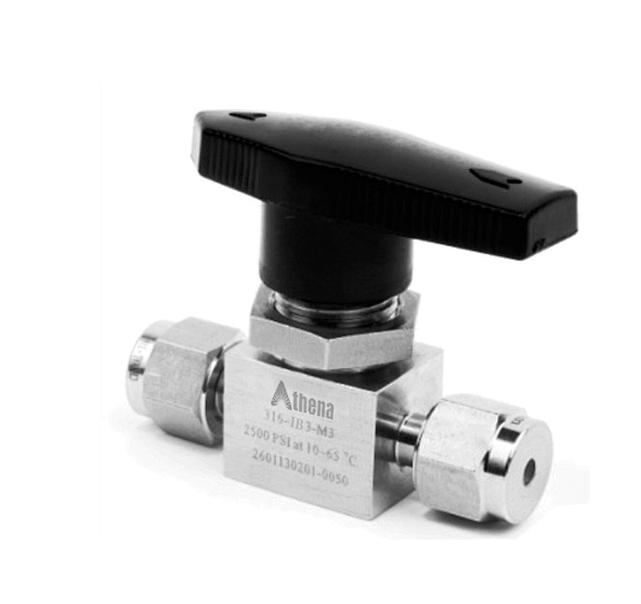
Athena instrument ball valves realize full opening and closing through 90-degree rotation of the ball core. Featuring simple lever operation, fast full-open and full-close action, low flow resistance, large flow capacity and stable sealing performance, they are perfectly suitable for working conditions requiring frequent switching.
Primarily applied as on-off valves, they are not applicable for precise flow regulation. Made of forged stainless steel, the valves feature a compact structure, which perfectly fits the narrow installation space of instrument panels.
Core Product Advantages
Athena Needle Valve: Outstanding regulation accuracy, high pressure resistance, high-strength forged body, excellent performance in precise micro-flow control, and stable adaptability for continuous fine adjustment and medium isolation.
Athena Instrument Ball Valve: 90-degree rapid opening and closing, ultra-low flow resistance, strong flow capacity, long service life of switching cycles, focusing on efficient pipeline on-off control.
The full product series takes 316 stainless steel as the base material, with special alloy options such as Hastelloy and Monel available for special working conditions. Ferrule connection requires no on-site welding, enabling convenient disassembly and assembly. All valves pass strict factory pressure tests to ensure excellent low-leakage performance.
Application Scenarios
Needle valves are widely used for pipeline isolation, pressure fine adjustment and high-pressure sampling loops on impulse lines of pressure gauges and pressure transmitters.
Instrument ball valves are commonly applied in sampling pipelines, purge loops and instrument piping that demands frequent and fast switching.
In petrochemical, oil & gas and power plant sites, Athena needle valves and ball valves are usually used in combination. Needle valves undertake fine isolation and flow regulation, while ball valves are responsible for rapid pipeline opening and closing.
Summary
Needle valves and ball valves are the two core products of Athena’s instrument valve series. Needle valves specialize in precise throttling and reliable pipeline isolation, while ball valves focus on efficient and rapid on-off control.
With superior advantages of high pressure resistance, corrosion resistance, low leakage rate and traceable material quality, Athena instrument valves guarantee accurate industrial measurement data and effectively protect precision field instruments. They serve as highly reliable fluid control supporting solutions for modern industrial automatic processes.
 What is Bi-Directional Valves?
  How Does a Ball Type Check Valve Prevent Pipeline Medium Backflow?
  Selection and Precautions for Natural Gas Valves
  Athena Engineering S.R.L Wraps‑up OGA 2026 Kuala Lumpur
  What is a Gate Valve? What is Its Working Principle?
  T-Type / T-Pattern / Straight Pattern Globe Valve
  Knife Gate Valve vs Wedge Gate Valve: Which Is Better for Your Industrial Piping?
  Cryogenic Ball Valve Comprehensive Product Overview
  Causes and Treatments for Poor Valve Shut‑Off
  Athena Triple Offset Butterfly Valves
  What is the Difference Between Swing Check Valve and NRV? A Complete Explanation
  Common Connection Types of Valves
  5 Piping Design Mistakes That Are Killing Your Valves
  Float Valve: Structure, Principle and Application
  High Pressure Needle Valve High-Precision Fluid Control Valve
  What is a Piston Check Valve?
  Meet Us at OGA 2026 | Booth 6802, Hall 6
  What is a Level Gauge? Working Principles, Types and Industrial Applications
  Double Sealing Protection: A Complete Interpretation of Bellows Globe Valves
  End-Suction Pump vs Inline Pumps: Which One Is Right for You?