
Slurry Knife Gate Valve
author: ATHENA GROUP
2026-10-26
1.The Athena brand slurry knife gate valve
Athena Brand Slurry Knife Gate Valve is a heavy-duty isolation valve specially developed for tough slurry, tailings, sludge, pulp and solids-laden abrasive media. Built on Athena’s decades of valve engineering experience, this series is purpose-built to solve common pain points in slurry pipelines: jamming, fibre wrapping, seat erosion and frequent unplanned maintenance that plague ordinary knife gate valves.
The core of the Athena slurry knife gate valve is its precision hardened knife-edge gate. When closing, the sharp blade cleanly shears tangled fibres, flocs and solid agglomerates, preventing material entrapment between gate and seat. It adopts a full-bore, straight-through cavity-free body design. With no dead pockets for sediment accumulation, the valve maintains minimal pressure loss and unobstructed flow, which is essential for high-solid-content slurry transportation. Face-to-face dimensions follow MSS SP-81, fully compatible with global piping standards and inspection requirements such as API 598 hydro static test.
Athena offers flexible sealing configurations to match different process fluids. The resilient sleeve seat version delivers reliable bi-directional bubble-tight shut-off. Seat material options include EPDM, NBR, polyurethane and PTFE. Polyurethane sleeves are strongly recommended for highly abrasive sharp particle slurry; EPDM suits general sludge and pulp; PTFE is selected for corrosive chemical slurries. Metal-seated variants are available for high-temperature services where soft elastomers cannot survive.
Multiple body and wetted materials are available upon request: cast iron, ductile iron, carbon steel WCB, AISI 304, AISI 316L, duplex steel and special alloys. End connections cover wafer, lug and flanged types to ASME B16.5. Actuation choices include hand wheel, gear operator, pneumatic single/double acting, electric actuator and hydraulic drive, supporting manual local operation, automatic remote control and emergency shutdown. The compact thin-body structure saves installation space and simplifies on-site replacement.
This Athena valve serves core industrial sectors worldwide. In mining and mineral processing, it isolates cyclone feed lines, tailings discharge and ore slurry circuits. In pulp and paper mills, it handles wood pulp and recycled stock. Power plants use it for fly ash and bottom ash slurry lines. It is also widely adopted in wastewater sludge treatment, dredging, mineral chemical slurry and sand handling systems.
Maintainability is a key design focus of Athena slurry knife gate valves. Wearing components such as sleeve seats and packing can be replaced conveniently without removing the whole valve from the pipeline, cutting downtime and spare-part costs. Every unit undergoes strict factory pressure testing before shipment to guarantee consistent sealing performance.
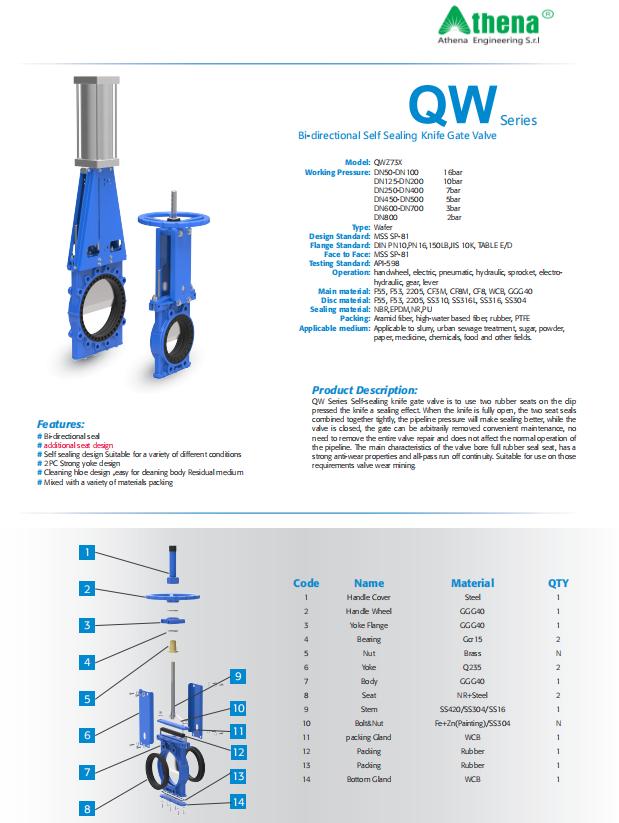
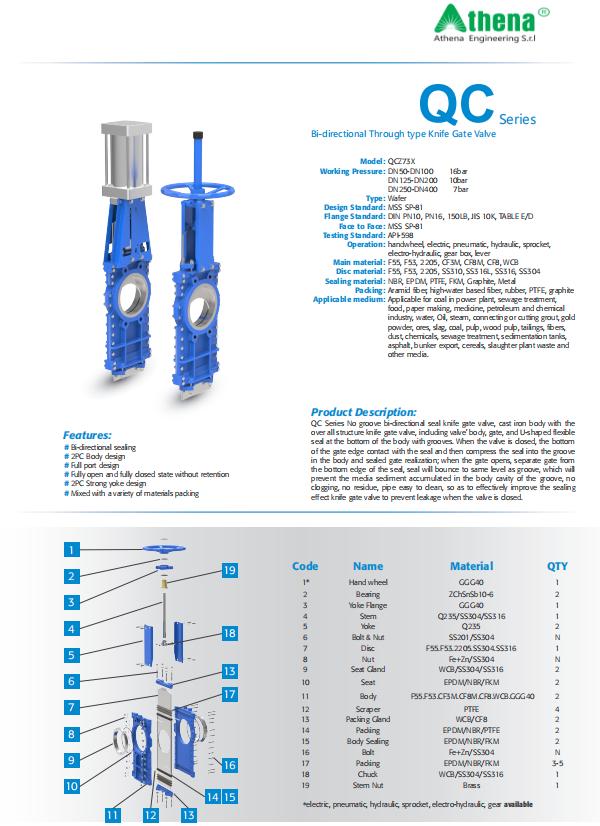
2. Adopted Design & Test Standards (Credibility Backing)
All technical design, dimension configuration, manufacturing inspection and performance test items follow globally recognized industrial valve standards, supporting third‑party inspection and material 3.1 certification delivery for project level procurement.
Design standards
MSS SP 81: core design specification for resilient seated knife gate valves
ASME B16.34: pressure temperature rating, body structural dimension
API 6D: supplementary specification for slurry service isolation valve requirements
EN 12516: European system pressure bearing shell design standard
Test standards
API 598: shell hydro static test, seat tightness test, bi directional leakage verification
ISO 5208: industrial valve pressure testing; leakage rate classification Rate A D
MSS SP 151: slurry simulation abrasion cyclic test for heavy duty knife gate products
Optional certification: CE marking for European‑market delivery; ISO 9001 quality system compliance for whole manufacturing process.
Important note: Shell hydro static test pressure equals 1.5 × nominal pressure; seat sealing test pressure equals 1.1 × nominal pressure, performed bi directionally for bi directional sealing configurations.
3. Complete Technical Parameter Scope
Size Range: NPS 2”NPS 48”; DN50 DN1200; extra large non standard sizes available upon custom request
Pressure class
ANSI Class 150LB, Class 300LB as mainstream heavy duty options
PN6, PN10, PN16, PN25, PN40 metric pressure grades
Operating temperature envelope (depends on seat and body material combination)
Elastomer resilient seat:-20 °C ~ +120 °C
PTFE based composite seat:-20 °C ~ +200 °C
All metal hard seat configuration:-20 °C ~ +420 °C
Allowable medium solid mass fraction: 0 %-70 %, subject to particle hardness, particle size distribution and flow velocity
Actuation modes: manual hand wheel, gear box manual, pneumatic single acting / double acting, electric multi turn actuator, hydraulic drive
Mounting pattern: wafer style, lug style, flanged connection conforming to ASME B16.5
Flow pass type: full bore (standard configuration for slurry service); reduced bore upon special request
A.Full bore design value point
Full bore inner diameter matches pipeline inner diameter, eliminating sudden cross section contraction. Practical site data demonstrate full bore construction reduces local flow velocity by 32‑45 % compared with reduced bore structures, cutting local erosion rate sharply and extending valve service cycle by 40‑60 % in abrasive slurry pipelines. Reduced bore versions are not recommended for continuous abrasive slurry working conditions.
B.Bi‑directional sealing explanation
Most heavy duty slurry knife gate valve configurations realize bi directional tight shut off. Either flow direction can bear full nominal differential pressure without exceeding allowed leakage rate, perfectly fitting slurry pipelines with potential back flow during pump stop over, gravity flow circuits and thickener underflow loops. Some low cost basic grade knife gate valves only provide unidirectional sealing; users must confirm sealing direction before ordering according to actual process conditions.
4.Key Performance Advantages versus Other Valve Categories
Field benchmark comparison targeted at slurry isolation scenarios, analyzing strengths and limitations versus wedge gate valve, butterfly valve and ball valve.
Heavy-duty Abrasive-Resistant Industrial Knife Gate Valves With Petroleum Equipment Zero Leakage Slurry Valve
Advantage 1: Built in shear capability to process fibrous medium
When closing, knife edged blade directly cuts paper fibers, biological floccule , plant fiber impurities, avoiding fiber entrap caused incomplete shut off, a common failure mode for wedge gate and ball valves. In pulp and paper thick stock pipeline applications, field feedback shows slurry knife gate valve fault rate drops by more than 70 % compared with traditional wedge gate valves.
Advantage 2: Full bore straight through flow channel, low deposition tendency
When fully open, no structural parts intrude inside flow path. Heavy solid particles will not deposit inside valve cavity, greatly reducing valve blocking risk during intermittent operation.
When fully open, no structural parts intrude inside flow path. Heavy solid particles will not deposit inside valve cavity, greatly reducing valve blocking risk during intermittent operation.
Advantage 3: Compact overall dimension, saving installation space
Under identical nominal diameter and pressure grade, face to face dimension of wafer style slurry knife gate valve is 40~65 % shorter than conventional wedge gate valve. This characteristic is especially valuable for old plant retrofit projects with limited on site layout space.
Under identical nominal diameter and pressure grade, face to face dimension of wafer style slurry knife gate valve is 40~65 % shorter than conventional wedge gate valve. This characteristic is especially valuable for old plant retrofit projects with limited on site layout space.
Advantage 4: Modular replaceable seat design, convenient on site maintenance
Without removing valve body off pipeline, operators can replace sealing cartridge, inspect blade wear status. Mean time repair (MTTR) can be controlled within 1~2 working hours; contrastingly, many other valve types require whole valve disassembly and off site overhaul.
Without removing valve body off pipeline, operators can replace sealing cartridge, inspect blade wear status. Mean time repair (MTTR) can be controlled within 1~2 working hours; contrastingly, many other valve types require whole valve disassembly and off site overhaul.
Advantage 5: Clear limitation reminder (objective description)
This valve is designed only for on-off isolation service; long term throttling will quickly destroy seat and blade by high speed particle scouring.
Under ultra high hardness sharp particle medium, even heavy duty versions still show natural wear and tear; periodic inspection and wearing part replacement remain indispensable.
For working conditions with huge particle size exceeding 1/3 nominal diameter, pre-installation screening equipment is suggested.
5.Industrial Segment by Segment Application Analysis
According to Google Analytics industrial valve user access data and global project case statistics, slurry knife gate valve highest demand industries are mining mineral processing, pulp and paper, municipal and industrial waste water, thermal power ash handling, chemical process slurry. Detailed scenario descriptions as follows.
A. Mining and mineral processing (largest application market)
Typical medium: iron ore / copper ore / gold ore tailings slurry, thickener underflow concentrate slurry, flotation circuit pulp, mine dewatering slurry, tailings transport pipeline. Solid mass fraction commonly reaches 30-70 %.
Main function: pipeline isolation during equipment maintenance, on-off control for tailings delivery pump outlet.
Recommended configuration priority: full bore, 6 hard faced blade, ductile iron / WCB body, flushing port structure, EPDM or PTFE seat, pneumatic actuation for most cases.
Site reference phenomenon: many mines previously used ordinary butterfly valves, needing replacement every 2-4 months; after switching to professional slurry knife gate valve, average operating cycle promoted to 12-24 months.
B. Pulp and paper making industry
Typical medium: wood pulp, recycled fiber stock, black liquor sludge, bleaching filtrate containing fiber debris.
Main application points: stock chest outlet, digester auxiliary pipeline, filtrate loop isolation.
Core value: knife blade shearing action prevents fiber winding jamming faults. EPDM resilient seat realizes reliable bubble tight shut off.
C. Municipal and industrial waste water treatment
Typical medium: primary sludge, digested biological sludge, filter press feed slurry, industrial ETP abrasive sediment containing effluent.
Typical working pressure PN10 / PN16; mainstream size NPS 3”-NPS 12”.
Suggested material combination: ductile iron body + SS304 blade + EPDM seat. Manual or pneumatic actuation according to automation level.
D. Thermal power generation ash handling system
Typical medium: fly ash slurry, bottom ash transport slurry from coal fired boiler. Medium contains hard silicon aluminum ash particles with strong abrasiveness.
Engineering suggestion: prioritize hard faced blade configuration; strengthen regular inspection frequency for sealing components.
E. Chemical industry abrasive and corrosive suspension
Typical medium: chemical precipitation slurry, pigment suspension, phosphate slurry.
Select body and seat material strictly based on pH value, ion composition, temperature. Duplex steel body + FKM / PTFE sealing parts for high corrosion scenarios.
6.Scientific Selection Procedure
Wrong model selection accounts for 60 % of early stage on site failures.
Below step by step selection work flow guides engineers complete parameter confirmation.
A. Collect fundamental process data first
Nominal pipe diameter and expected valve size; keep full bore preference principle
Max working pressure, normal operating pressure, max differential pressure at valve closing moment
Medium properties
Solid mass fraction, particle hardness, maximal particle size
Medium pH value, corrosive ion type (chloride ion etc.)
Working temperature range
Flow velocity design value: high flow velocity accelerates abrasion damage, try to control slurry pipeline flow velocity within 1.5 3 m/s scope as far as process conditions allow
Operation requirement: manual or automatic actuation; safety action demand (fail open / fail close); estimated annual switch cycle times
Pipeline connection form: wafer, lug, flanged ASME B16.5
B. Determine sealing direction and sealing type
Process pipeline existing back flow risk: select bi-directional sealing configuration
Pursue bubble tight isolation performance: resilient elastomer seat first choice
High temperature condition beyond elastomer allow range: choose metal hard seat and accept corresponding leak rate index.
C.Confirm material combination matrix according to medium attributes
316 Stainless Wear Resistant Zero Leakage High Pressure Knife Slurry Valve for Mining Operations
Refer to section 4 component material introduction; avoid blind cost reduction by downgrading material grade for heavy abrasion and corrosion working conditions.
D. Special function option evaluation
High solid fraction slurry: evaluate whether flushing port structure needs to be added
Frequent automated switch service: prioritize high strength 17-4PH stem material
Outdoor open air installation: require high quality anti-corrosion coating for valve body and actuator housing.
E. Verify standard and document requirement
Confirm design and test standard matching project specification; clarify delivery document requirement: material certificate 3.1, test report, CE certificate or other project required paperwork.
Common selection pitfall: Simply copy valve nominal pressure equal to pipe design pressure while ignoring medium abrasion and corrosion attributes, adopting ordinary knife gate valve to replace professional slurry knife gate valve. This practice will lead to very short on site service cycle and higher comprehensive operating cost in spite of low initial purchase price.
7.Installation, Commissioning & On‑Site Operation Specification
Even correct model selection can not guarantee stable performance without standard installation and operation.
A. Installation requirements
Recommended installation orientation: stem vertical upward (horizontal pipeline mounting). Side mount installation is allowed only for special layout limitation but will increase actuator load and uneven wear risk.
Sufficient operation space reserved above actuator to guarantee full stroke movement without obstacle.
Before valve installation complete pipeline blow down work to remove construction debris and welding slag inside pipe system prevent hard foreign object scratching seat and blade surface during first closing action.
For wafer style valve, strictly control flange bolt pre tightening torque uniform distribution; excessive uneven bolt force will deform valve body and cause seat leakage failure.
B. Pre-commissioning check items
Manually perform full open and full close stroke several times, verify no sticking or abnormal friction resistance
For pneumatic actuator configuration: check compressed air pressure matches actuator design requirement (general supply air pressure 0.4 - 0.6 MPa); drain water inside air source filter
Confirm valve stroke limit switch signal feedback works normally for electric or pneumatic automated versions
Do not apply external pipeline stress onto valve body ; eliminate pipeline misalignment stress before commissioning.
C. Operation prohibitions
Strictly forbid using valve at partial opening position for long time throttling regulation of slurry flow rate. This behavior causes high speed particle direct scouring on blade and seat surface leading to rapid irreversible damage. This valve only works under fully open or fully closed state.
Do not utilize actuator over torque to force closing when large foreign objects block gate travel path; stop operation immediately and eliminate blockage source to prevent blade bending permanent deformation damage.
8.Preventive Maintenance & Troubleshooting Guidance
Scientific preventive maintenance can effectively extend valve service life and reduce unexpected failure probability. Maintenance cycle should be adjusted according to actual medium abrasion severity; below content provides general reference baseline.
A. Periodic inspection items
Short cycle inspection (every 2 - 4 weeks for heavy abrasion slurry working condition)
Visual inspection: check external leakage at packing gland zone and flange joint surface
Confirm valve open close position matches local indicator and remote feedback signal
For flushing port equipped valves: inspect flushing fluid supply loop availability
Medium cycle inspection (every 3 - 6 months)
Carry out several complete switch operations under no process pressure condition if process permitted
Check packing pre-tightening condition; moderately compress packing gland when stem outer leakage occurs (avoid over compression causing excessive stem friction and accelerated packing aging)
Check actuator fastener loosening status; replenish lubricant according to actuator manual requirement
Overhaul cycle (according to on site experience feedback general 12-24 months for heavy duty slurry service)
Shut down system and isolate pressure source safely, disassemble modular seat cartridge to inspect seat elastic element aging and abrasion condition, measure blade sealing zone wear depth. Replace worn seat and damaged blade components in time.
Heavy-duty Abrasive-Resistant Industrial Knife Gate Valves With Petroleum Equipment Zero Leakage Slurry Valve
B. Typical fault phenomenon and probable root cause
Valve can not achieve tight shut off after closing
A: Fiber or solid particles trapped between blade and seat sealing face. Perform repeated open close cycles to try to wash away clamped debris; if problem persists need on site disassembly inspection
B: Seat elastic element suffered abrasion or permanent deformation after long time operation ; replace replaceable seat cartridge
C: Blade sealing edge scratched or locally worn seriously due to hard particle impact damage
Stem packing zone medium out leakage
A: Packing material gradually aging and loosening ; properly tighten gland bolts uniform torque
B: Slurry solid particles invaded packing clearance causing stem surface scratch damage ; adopt flushing port design for new project to avoid re-occurrence
Abnormally large operation torque during opening closing stroke
A: Medium sediment accumulated inside valve body guide groove , block blade move travel ; eliminate sediment deposit
B: Stem lubrication insufficient or corrosion occurred on stem surface
C: Blade slightly bended deformation caused by excessive unbalanced differential pressure shock load
Safety reminder: All maintenance work must be executed after system pressure relief and medium isolation completed to prevent personal safety incidents caused by unexpected medium spray out.
Athena Group www.athenavalve.com stands behind this product with professional technical support and customisation service. Our engineering team works closely with clients to confirm solid concentration, particle hardness, temperature, chemical compatibility and actuation logic, to deliver a properly specified slurry knife gate valve for each unique project.
For abrasive slurry isolation where reliability matters, Athena Brand Slurry Knife Gate Valve is your trusted choice — robust, anti-clogging, easy to maintain and proven in the harshest slurry service conditions.
For abrasive slurry isolation where reliability matters, Athena Brand Slurry Knife Gate Valve is your trusted choice — robust, anti-clogging, easy to maintain and proven in the harshest slurry service conditions.
 2026 Ranking of the World’s Top 10 Ball Valve Brands
 How to Select Part‑Turn, Linear‑Stroke and Multi‑Turn Electric Actuators
 How to Fix a Leaking Ball Valve
 How to Repair a Gate Valve
 Pressure Seal Type Gate Valve for High-Pressure High-Temperature Industrial Isolation
 What Are the Differences Between Forged Valves and Cast Valves?
 Characteristics, Applications and Advantages of Carbon Steel Globe Valves
 Why Are Instrument Valves Indispensable for Industrial Control Systems?
 What is Bi-Directional Valves?
 How Does a Ball Type Check Valve Prevent Pipeline Medium Backflow?
 Selection and Precautions for Natural Gas Valves
 Athena Engineering S.R.L Wraps‑up OGA 2026 Kuala Lumpur
 What is a Gate Valve? What is Its Working Principle?
 T-Type / T-Pattern / Straight Pattern Globe Valve
 Knife Gate Valve vs Wedge Gate Valve: Which Is Better for Your Industrial Piping?
 Cryogenic Ball Valve Comprehensive Product Overview
 Causes and Treatments for Poor Valve Shut‑Off
 Athena Triple Offset Butterfly Valves
 What is the Difference Between Swing Check Valve and NRV? A Complete Explanation
 Common Connection Types of Valves