
What is the Difference Between Swing Check Valve and NRV? A Complete Explanation
author: ATHENA GROUP
2026-08-19

In complex industrial fluid‑control systems, valves are core components that guarantee stable operation of pipelines, pumps and various mechanical equipment. Among numerous pipeline valves, swing check valves and NRV (non‑return valves) are the two most widely‑used products for backflow‑preventing working conditions, and they are also the most confusing valve terms in the industry. Combining valve structural principles and design characteristics, this paper comprehensively analyzes the core differences between swing check valves and NRV, and incorporates professional practical experience from Athenavalve to provide references for industry type‑selection and application.
I. Core Conclusion: NRV is a General Category, and Swing Check Valve is a Sub‑Category
First clarify the core answer to all doubts to quickly address users’ primary search requirements:
NRV (Non Return Valve) is a general international collective term for all non‑return valves, belonging to a functional concept; the swing check valve is a classic sub‑model under the NRV category, representing a specific product‑structure concept.
In short: all swing check valves belong to NRV, yet NRV covers more than just swing‑type valves. This is the fundamental reason for frequent confusion between the two in the industry. There is no opposition in functional merits and demerits; only differences in category scope and structural form exist.
II. In‑depth Analysis: Basic Definitions and Working Principles of NRV and Swing Check Valve
1. What is NRV?
NRV is the abbreviation for Non Return Valve, a professional valve term commonly used in European and American international standards. It corresponds to Check Valve in the American standard system, whose official Chinese name is one‑way valve or check valve. It serves as a basic protective valve for industrial fluid systems.
An NRV has neither electric nor manual actuators. It opens and closes automatically completely relying on the pressure of the process medium. Its core function is to block fluid backflow, protect pipelines, equipment, pumps and technological processes from damage caused by backflow impact, and ensure operational integrity of the entire fluid system.
As a large valve category, NRV includes multiple sub‑models with distinct structures. Mainstream sub‑categories cover swing‑type, lift‑type, piston‑type, ball‑type, wafer‑type, and butterfly check valves. Each sub‑type varies greatly in structure, performance and applicable working conditions.
2. What is a Swing Check Valve? Working Principle and Structural Features
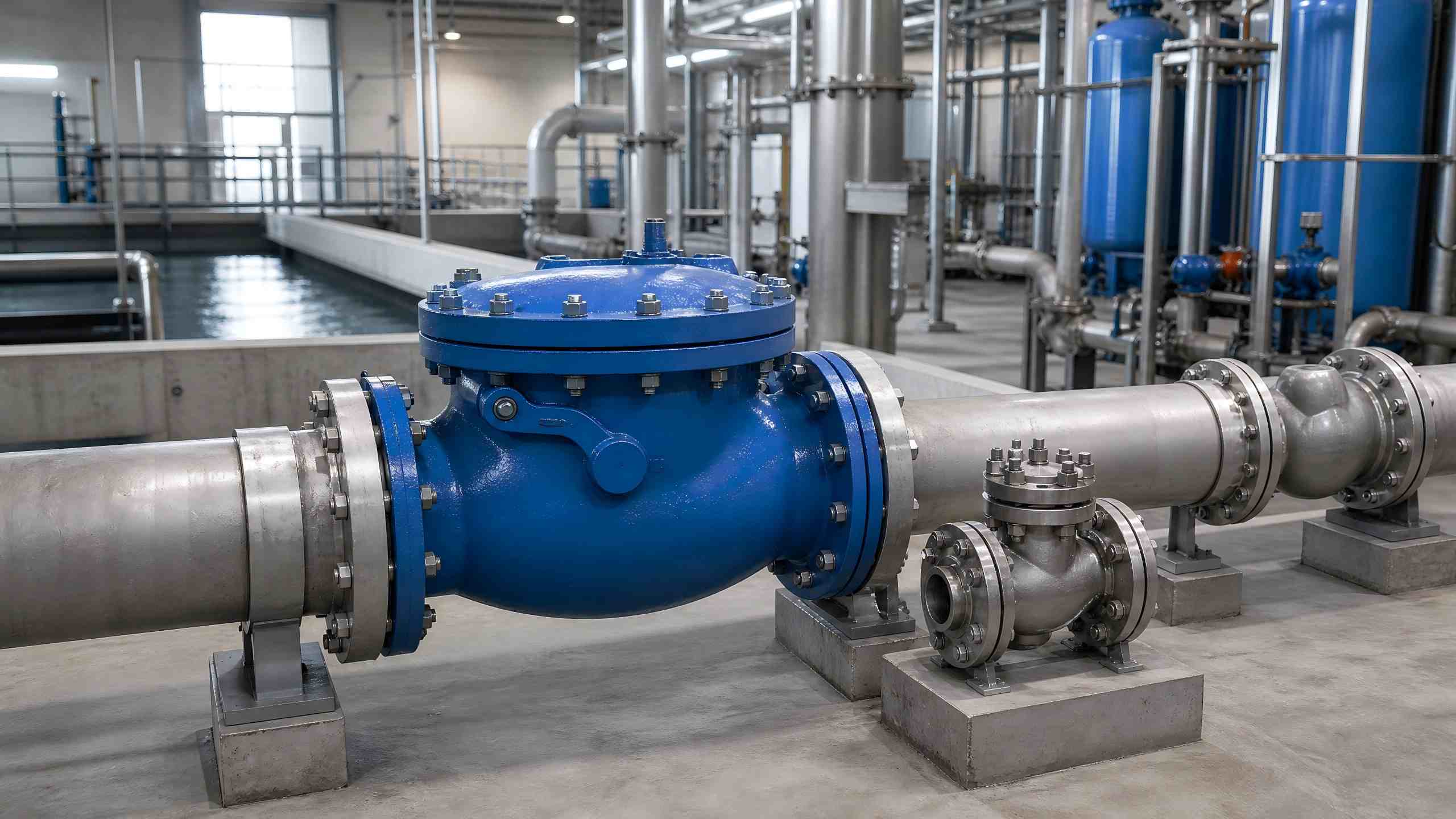
The swing check valve (Swing Check Valve) is one of the most widely‑applied and classically‑structured one‑way valves under the NRV umbrella. It is a practical physical valve model. Thanks to its simple structure and reliable performance, it is widely applied in most mainstream fluid pipelines.
Working principle: Its key component is a movable disc fitted with a hinge structure. When medium flows forward, fluid pressure pushes the disc to rotate around the hinge and move away from the seat, allowing full pipeline passage. When medium flow stops or reverse backflow occurs, back‑pressure of the medium together with the self‑weight of the disc presses the disc firmly against the seat sealing surface to quickly block medium backflow and realize one‑way sealing protection.
Design and installation: It features a simple overall structure consisting of four major parts: valve body, bonnet, hinge assembly and disc. It has few moving components and strong structural stability. The valve body can be manufactured from various materials such as stainless steel, cast iron and brass according to working conditions, suitable for clear water, sewage and general industrial fluids. It also allows easy disassembly and assembly with extremely low later‑stage maintenance costs.
III. Introduction to Various NRV Sub‑Categories
To better distinguish swing check valves from other NRV products, below is an introduction to mainstream NRV sub‑models in the industry, specifying applicable characteristics of different structures:
- Lift‑type NRV: Opens and closes via vertical lifting of the disc. It features compact structure and good sealing performance. It applies to small‑bore, high‑pressure and steam‑service pipelines, yet suffers from relatively high flow resistance.
- Piston‑type NRV: Adopts cylinder‑piston opening‑and‑closing construction with outstanding pressure‑bearing capacity. It is specially designed for industrial working conditions with high pressure and severe pressure shock.
- Ball‑type NRV: Uses a ball as the sealing and opening‑closing component. It resists jamming and suits process media with high viscosity such as crude oil and mud.
- Swing‑type NRV: Features large nominal diameter, low flow resistance and high flow capacity. It is mainly used for medium‑and‑low‑pressure large‑bore stable‑fluid pipelines, serving as a general‑purpose product for civil and industrial applications.
IV. Comprehensive Comparison of Core Differences: Swing Check Valve vs. General NRV
1. Difference in Term Property and Coverage Scope
- NRV: A purely functional general term. It only defines the function of “backflow prevention and one‑way flow”, without restrictions on structure, form or installation mode. It covers all one‑way valve types with full‑range coverage.
- Swing check valve: A specific product‑model term. It precisely defines the hinge‑swing opening‑and‑closing structure. It is a single sub‑set of NRV with fixed scope and definite reference.
2. Difference in Opening‑Closing Mechanism and Performance Features
- General NRV: Different sub‑types adopt vastly different opening‑closing mechanisms including swing, lift, piston and ball actuation. Their performance covers a wide range, and they can adapt to various complex working conditions such as low pressure, high pressure, high temperature, viscous fluid and pulsating flow. Some models produce large pressure drop while others deliver high pressure resistance.
- Swing‑type NRV: Operates through disc swing. Its core strengths lie in full‑bore design, extremely low pressure drop, minor flow loss and high flow capacity. Its drawbacks include continuous disc oscillation under low‑velocity fluid or pulsating‑flow conditions, which may accelerate component wear. Slight water hammer may occur under instantaneous high‑pressure backflow scenarios.
3. Difference in Installation Specifications
- Swing check valve: Optimally installed on horizontal pipelines. Vertical installation is permissible only when medium flows from bottom to top; otherwise normal sealing and operation cannot be achieved, resulting in relatively strict installation limitations.
- General NRV: Boasts broad adaptability across product types. Some lift‑type and piston‑type NRVs permit multi‑directional installation without constraints imposed by pipeline orientation, delivering higher flexibility.
4. Difference in Industrial Application Scenarios
- NRV: Mostly used in foreign‑trade drawings, European‑and‑American‑standard datasheets and general equipment marking. It describes only valve function as a general written abbreviation and cannot serve as an accurate procurement model number.
- Swing check valve: Used for precise procurement, construction installation, detailed pipeline design and working‑condition customization. It is a concrete product model for engineering implementation and can be directly adopted as procurement parameters.
V. Advantages and Limitations of Swing Check Valve and General NRV
1. Advantages and Limitations of Swing Check Valve
Core advantages: Simple construction, few moving parts, low failure rate and high long‑term operational stability; low pressure drop and minimal flow loss for energy‑saving effects; broad material compatibility, high cost‑performance, convenient disassembly, assembly and later‑stage maintenance with excellent overall economic efficiency.
Main limitations: Not suitable for pulsating‑fluid working conditions, as continuous disc oscillation will accelerate wear and shorten service life; strict flow‑direction requirements for vertical installation restrict applicable scenarios; slow closing response under low‑velocity‑medium working conditions.
2. Advantages and Limitations of General NRV
Core advantages: Abundant product types and strong versatility covering full‑range working conditions including high/low pressure, high/low temperature, viscous fluid and pulsating flow; certain models support multi‑directional installation to fit complex pipeline layouts.
Main limitations: Some high‑pressure special‑structure NRVs contain sophisticated components, leading to higher manufacturing and maintenance costs; partial models such as lift‑type and piston‑type NRVs feature high flow resistance and elevated pressure drop, increasing pipeline energy consumption.
Summary
NRV is the collective name for backflow‑preventing one‑way valves, while the swing check valve is one specific model within this category. No merits‑or‑demerits comparison exists between them; differences lie merely in scope and structure.
In drawing marking, foreign‑trade quotation and engineering procurement, never substitute NRV for a specific model number in a general manner. Athenavalve recommends precise type‑selection according to practical working conditions to guarantee system stability and avoid risks caused by improper type‑selection and construction.
 How Does a Ball Type Check Valve Prevent Pipeline Medium Backflow?
  Selection and Precautions for Natural Gas Valves
  Athena Engineering S.R.L Wraps‑up OGA 2026 Kuala Lumpur
  What is a Gate Valve? What is Its Working Principle?
  T-Type / T-Pattern / Straight Pattern Globe Valve
  Knife Gate Valve vs Wedge Gate Valve: Which Is Better for Your Industrial Piping?
  Cryogenic Ball Valve Comprehensive Product Overview
  Causes and Treatments for Poor Valve Shut‑Off
  Athena Triple Offset Butterfly Valves
  Common Connection Types of Valves
  5 Piping Design Mistakes That Are Killing Your Valves
  Float Valve: Structure, Principle and Application
  High Pressure Needle Valve High-Precision Fluid Control Valve
  What is a Piston Check Valve?
  Meet Us at OGA 2026 | Booth 6802, Hall 6
  What is a Level Gauge? Working Principles, Types and Industrial Applications
  Double Sealing Protection: A Complete Interpretation of Bellows Globe Valves
  End-Suction Pump vs Inline Pumps: Which One Is Right for You?
  Method of Selecting Valve Types Based on Throttling Degree
  Safety Valves–Core Protection for Pressure Equipment