
Valve Pickling Methods
author: ATHENA GROUP
2026-11-06
Athena Valve supplies stainless steel valves into chloride-bearing and acidic service, and pickling is one of the steps that most often decides how long those valves last. This guide sets out the pickling methods, the standard procedure and the common mistakes as Athena Valve's engineering team applies them in practice.
Pickling is a key step in stainless steel valve manufacturing and site installation that links what comes before and what comes after: it removes the oxide tint and contamination left by welding and machining, and it is followed by the rebuilding of the passive film. It directly determines the service life of the valve in chloride-bearing and acidic media. Choose the wrong method and the lightest consequence is acid staining or over-pickling; the heaviest is intergranular corrosion and seal failure. This article sets out in one place the pickling methods mainstream in engineering practice, the standard procedure and the common misconceptions.
Pickling is a key step in stainless steel valve manufacturing and site installation that links what comes before and what comes after: it removes the oxide tint and contamination left by welding and machining, and it is followed by the rebuilding of the passive film. It directly determines the service life of the valve in chloride-bearing and acidic media. Choose the wrong method and the lightest consequence is acid staining or over-pickling; the heaviest is intergranular corrosion and seal failure. This article sets out in one place the pickling methods mainstream in engineering practice, the standard procedure and the common misconceptions.
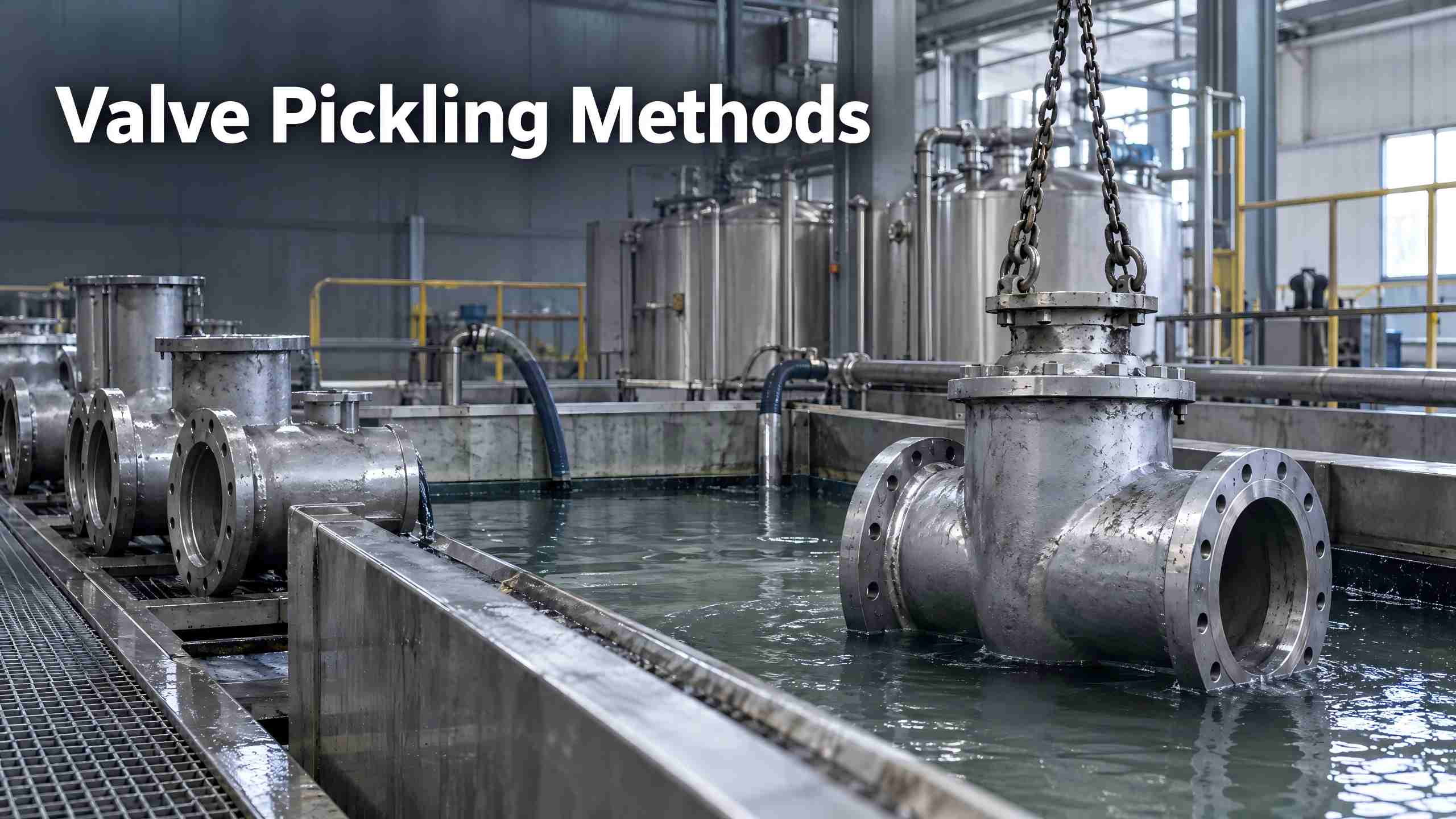
1. First, Be Clear About What Pickling Is Actually “Washing”
Pickling of stainless steel valves (commonly called “pickling and passivation” in engineering practice) deals with three things: the oxide tint (heat tint) in the weld heat-affected zone, oxide scale and free iron, and oil and flux residue. Pickling is responsible for “removing contamination and descaling”; passivation is responsible for “rebuilding the chromium-rich passive film on the freshly exposed metal surface”. The two steps must be carried out in sequence. Pickling without passivation actually leaves corrosion resistance worse.
One confusion comes up very often: pickling of carbon steel valves is “derusting” (hydrochloric or sulfuric acid plus an inhibitor), and after pickling an anti-rust layer is applied, with no passivation involved; pickling of stainless steel valves is “cleaning plus restoring passivity”. Hydrochloric acid must never be used on stainless steel parts: chloride ions plant the seeds of pitting corrosion and stress corrosion cracking.
Typical occasions that require pickling: before a new valve leaves the factory, after welding or repair on site, when rust spots or oxide tint appear on the surface, and before commissioning of high-cleanliness systems such as food and pharmaceutical systems.
2. Five Mainstream Pickling Methods and Their Applications
Ratios and temperature ranges are subject to ASTM A380 / A967 and the condition in which the material is supplied. Hydrofluoric acid is highly toxic; the site must be ventilated and calcium gluconate kept on hand for emergencies. Duplex steel is more sensitive to the ratio and should be treated according to the material manufacturer's instructions.
| Method | Acid system (common engineering range) | Suitable for | Characteristics |
| Immersion pickling | Nitric acid 10%, 30 min | Small valve manufacturing parts, dismantled repair parts | Uniform and thorough, highest efficiency; requires space and waste liquor treatment |
| Spray pickling | Atomised mixed-acid spray | Mass-production valve lines | Automated, saves acid, suited to volume |
| Brush / gel pickling | Pickling paste (gelled mixed acid) | Site welds, local areas of large valves | No need to move equipment, low consumption; uniformity depends on technique |
| Circulation pickling | Citric acid or dilute nitric acid pumped in circulation | Stainless steel piping systems in service | Covers the whole loop; soft seals and instruments must be isolated |
| Electrolytic pickling / electropolishing | Electrolyte plus current | Food-, pharmaceutical- and semiconductor-grade valves | Controllable roughness, low residual-acid risk; high equipment investment |
3. Standard Six-Step Procedure
Degreasing and oil removal: use a chlorine-free alkaline cleaner to remove oil. If the oil is not fully removed, the pickled surface will certainly be patchy.
Pickling: set the ratio, temperature and time by material (304/316L/duplex), and pull the part out the moment the time is up.
Rinsing: flush with plenty of clean water until the pH is neutral; for critical valves use deionised water (chloride ions ≤25 mg/L).
Neutralisation: neutralise residual acid with a 1%–2% sodium carbonate weak alkaline solution.
Passivation: nitric acid 20% at 60 °C for 20–60 min to rebuild the passive film.
Inspection and packaging: sample-check by the blue-spot method or the water-film method, then clean, dry, plug and protect against secondary contamination.
A note on soft-seated valves: PTFE and EPDM do not resist acid. Remove the seals before pickling, or switch to the gel method to keep clear of the sealing surfaces. Spent acid and waste liquor must be neutralised and settled; chromium- and nickel-bearing wastewater must be handed to a licensed unit for disposal in line with environmental requirements.
Pickling: set the ratio, temperature and time by material (304/316L/duplex), and pull the part out the moment the time is up.
Rinsing: flush with plenty of clean water until the pH is neutral; for critical valves use deionised water (chloride ions ≤25 mg/L).
Neutralisation: neutralise residual acid with a 1%–2% sodium carbonate weak alkaline solution.
Passivation: nitric acid 20% at 60 °C for 20–60 min to rebuild the passive film.
Inspection and packaging: sample-check by the blue-spot method or the water-film method, then clean, dry, plug and protect against secondary contamination.
A note on soft-seated valves: PTFE and EPDM do not resist acid. Remove the seals before pickling, or switch to the gel method to keep clear of the sealing surfaces. Spent acid and waste liquor must be neutralised and settled; chromium- and nickel-bearing wastewater must be handed to a licensed unit for disposal in line with environmental requirements.
4. Five Common Misconceptions
1. “Conveniently” cleaning stainless steel valves with hydrochloric acid: many articles online recommend pickling stainless steel valves with hydrochloric acid or a mixed acid containing it. This is wrong: chloride ions are precisely the starting point of pitting and stress corrosion. Use a nitric-plus-hydrofluoric acid system or a citric acid system.
2. Pickling without passivation: the surface is fresh but carries no passive film, so it corrodes faster.
3. Soaking overtime in pursuit of “cleanliness”: over-pickling causes intergranular corrosion and a rough surface.
4. Touching the surface with ordinary steel wire brushes or carbon steel tools: this embeds free iron, and rust spots are certain to appear later. Use dedicated stainless steel brushes and aluminium-based abrasives.
5. Applying pickling paste and then neither rinsing nor neutralising: residual acid crystallises and corrodes slowly once the valve is in service.
5. How to Choose a Method
For small newly made parts and batch parts, choose immersion or spray pickling; for site welds and repairs, choose pickling paste; for systems in service, choose circulation pickling (isolating soft seals and instruments first); for high-cleanliness duty, choose electropolishing; for castings with thick oxide scale, grit-blast or shot-blast before pickling.
FAQ
Q1: Are pickling and passivation the same thing?
No. Pickling is the “cleaning” step that removes oxide scale, oxide tint and free iron; passivation is the subsequent step that rebuilds the chromium-rich passive film on the clean surface using nitric or citric acid. The two are usually performed in sequence and together called pickling and passivation, but their functions differ.
Q2: Will pickling damage the valve sealing surfaces?
Q2: Will pickling damage the valve sealing surfaces?
Yes. Hard seals (Stellite alloy, cemented carbide) resist acid reasonably well, while soft seals (PTFE, EPDM, NBR) are attacked by acid. Soft-seated valves should have their seals removed, or the gel method used to keep clear of the sealing zone; after pickling, the sealing surfaces should be re-lapped and checked.
Q3: How is the work accepted after pickling?
Q3: How is the work accepted after pickling?
Three methods are common in engineering practice: the blue-spot method (potassium ferricyanide–nitric acid drop test, with no blue stain indicating acceptable free iron), the water-film method (a continuous water film indicating a clean, acceptable surface), and where necessary a neutral salt spray test. For large batches, sample-check to ASTM A967 / A380 and the project specification.
Q4: Can pickling replace routine corrosion protection?
Q4: Can pickling replace routine corrosion protection?
No. Pickling and passivation only restore the surface to its initial passivated state; they cannot replace media selection, anti-corrosion coatings and periodic maintenance. If rust spots keep reappearing after commissioning, investigate chloride concentration and the operating conditions first before deciding whether to repeat the pickling.
Every pickling method above only works when it is matched to the actual material, media, pressure and temperature — and that matching is exactly where Athena Valve's engineering team works with customers, covering eccentric, lubricated, non-lubricated and pressure-balanced plug valves, along with the corresponding pickling and passivation requirements, before the valve is put into chloride-bearing or acidic service. If you are evaluating valves for a demanding application, Athena Valve's engineering team is available for technical consultation on your specifications and application-specific recommendations.
Every pickling method above only works when it is matched to the actual material, media, pressure and temperature — and that matching is exactly where Athena Valve's engineering team works with customers, covering eccentric, lubricated, non-lubricated and pressure-balanced plug valves, along with the corresponding pickling and passivation requirements, before the valve is put into chloride-bearing or acidic service. If you are evaluating valves for a demanding application, Athena Valve's engineering team is available for technical consultation on your specifications and application-specific recommendations.
 Concentric vs. Eccentric Butterfly Valve: Which Suits HVAC and Water Systems?
 Slurry Knife Gate Valve
 2026 Ranking of the World’s Top 10 Ball Valve Brands
 How to Select Part‑Turn, Linear‑Stroke and Multi‑Turn Electric Actuators
 How to Fix a Leaking Ball Valve
 How to Repair a Gate Valve
 Pressure Seal Type Gate Valve for High-Pressure High-Temperature Industrial Isolation
 What Are the Differences Between Forged Valves and Cast Valves?
 Characteristics, Applications and Advantages of Carbon Steel Globe Valves
 Why Are Instrument Valves Indispensable for Industrial Control Systems?
 What is Bi-Directional Valves?
 How Does a Ball Type Check Valve Prevent Pipeline Medium Backflow?
 Selection and Precautions for Natural Gas Valves
 Athena Engineering S.R.L Wraps‑up OGA 2026 Kuala Lumpur
 What is a Gate Valve? What is Its Working Principle?
 T-Type / T-Pattern / Straight Pattern Globe Valve
 Knife Gate Valve vs Wedge Gate Valve: Which Is Better for Your Industrial Piping?
 Cryogenic Ball Valve Comprehensive Product Overview
 Causes and Treatments for Poor Valve Shut‑Off
 Athena Triple Offset Butterfly Valves