
Stainless Steel Angle Globe Valve
When a line must change direction at the valve location, this configuration combines flow control and the directional change into one component, eliminating an external elbow and a separate valve. The result is a more compact, economical, and reliable piping arrangement.
At Athena, we manufacture stainless steel angle globe valves for chemical processing, power generation, oil and gas, water treatment, steam systems, marine, and HVAC applications.
Constructed from high-grade stainless steels such as SS304, SS316, and SS316L, these valves deliver excellent corrosion resistance, mechanical strength, and long-term sealing performance in handling aggressive fluids, gases, and steam. This guide brings together the engineering principles, verified specifications, and selection criteria you need to specify the right valve for your service.
What Is a Stainless Steel Angle Globe Valve?
An angle globe valve belongs to the globe valve family. Its defining feature is the body geometry: the inlet and outlet ports are arranged at roughly a 90-degree angle to each other, so the media enters along one axis and leaves along a perpendicular axis. Inside, the valve retains the classic globe-valve closure mechanism — a stem moves a disc linearly toward or away from a seat to open, throttle, or shut off flow.
In industrial terminology, the terms angle globe valve, angle type globe valve, angle pattern globe valve, 90 degree globe valve, and right-angle globe valve all describe the same body configuration.
It is important to understand what these terms do not mean: an "angle" or "90°" designation describes only the body pattern, not a complete valve specification. Pressure class, material, bonnet construction, end connections, trim, flow direction, dimensions, operation, testing, and documentation are all separate engineering decisions that must be defined independently.
This distinction matters for buyers. A valve described simply as "90-degree angle" is only partially specified. A technically complete specification is built from several independent axes, each requiring its own basis.
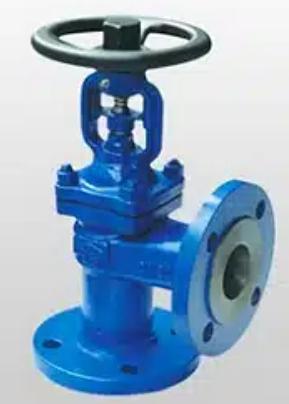
Design and Working Principle
The operating principle is straightforward and highly reliable: stem movement → disc position → seat opening → shutoff or throttling.
- Linear closure: Rotating the handwheel (or driving an actuator) moves the stem axially, pressing the disc against the seat to close or lifting it to open. This linear, wipe-free seating action provides tight shutoff and good throttling control.
- 90° flow path: The angled body routes the inlet and outlet at right angles. The media changes direction as it passes through the valve, which is precisely what makes the valve useful where the piping already needs to turn.
- Throttling capability: Because flow is regulated by the position of the disc relative to the seat, the valve supports both isolation and manual flow regulation. For demanding, continuous modulating duty, however, a deeper review of differential pressure, flow rate, trim design, medium, temperature, and travel is required — a throttling-capable valve is not automatically a sized control valve.
Key Features and Advantages
1.Integrated flow control and direction change — Regulation and a 90° turn are combined in a single body, reducing the number of fittings and connections in the system.
2.Compact, space-saving design — By removing the need for a separate elbow and valve, the valve saves installation space and reduces potential leak paths.
3.Robust stainless steel construction — Resistant to corrosion, high temperatures, and mechanical stress, with excellent durability in aggressive media.
4.High throttling accuracy — Linear stem-and-disc movement allows precise flow adjustment for a wide range of duties.
5.Leakage-free shutoff — Metal-to-metal or soft-seat options deliver reliable, tight sealing.
6.Versatile operation — Available with handwheel, gear operator, pneumatic actuator, or electric actuator.
7.Wide pressure and temperature capability — Engineered for demanding industrial systems.
8.Standards compliance — Designed and tested to API, ASME, and DIN/EN standards.
Material Options
Material selection always begins with the process conditions — medium, pressure, temperature, and corrosion requirements — not with the word "stainless." Common material routes for stainless steel angle globe valves include:
- SS304 (CF8): General-purpose austenitic stainless steel with good corrosion resistance for water, steam, and many process utilities.
- SS316 (CF8M): Molybdenum-bearing stainless steel with improved resistance to pitting and crevice corrosion, widely used in chemical and marine service.
- SS316L: Low-carbon variant offering enhanced resistance to intergranular corrosion after welding — ideal for welded and high-corrosion applications.
- Duplex stainless steel: Higher strength and superior resistance to stress-corrosion cracking for severe service.
Technical Specifications
Table 1. Technical specifications of stainless steel angle globe valves
| Parameter | Details |
| Material Grades | SS304, SS316, SS316L, Duplex Stainless Steel |
| Design Type | Angle Type Globe Valve (90° flow path change) |
| Size Range | ½" (DN15) to 24" (DN600) |
| Pressure Ratings | ANSI Class 150, 300, 600, 900, 1500 |
| Temperature Range | -29°C to +450°C (depending on material and seat design) |
| Bonnet Design | Bolted Bonnet, Welded Bonnet |
| Disc Types | Plug Disc, Needle Disc, or Composite Disc |
| Operation Options | Handwheel, Gear, Pneumatic Actuator, Electric Actuator |
| End Connections | Flanged (ASME B16.5), Threaded (BSP/NPT), Butt Weld (ASME B16.25) |
| Flow Characteristics | High throttling accuracy with 90° flow diversion |
| Standards Compliance | API 623, ASME B16.34, BS EN 13709 |
| Leakage Test | API 598 compliant (hydrostatic and seat leakage tests) |
| Applications |
Oil & Gas, Chemical Processing, Steam Systems, Marine, Power Plants, Water Treatment, HVAC
|
Standards and Testing
Athena designs and tests angle globe valves to internationally recognized standards: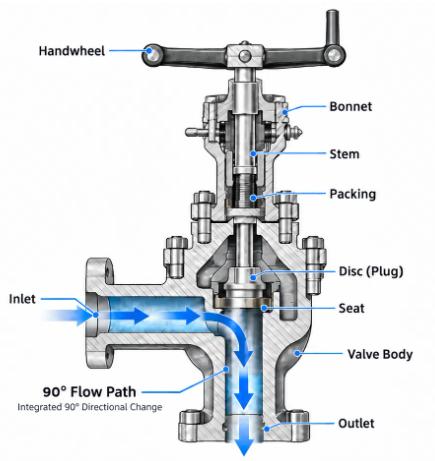
- API 623 — Design standard for steel globe valves used in petroleum, petrochemical, and natural gas industries.
- ASME B16.34 — Valves — flanged, threaded, and welding end, covering pressure-temperature ratings and materials.
- ASME B16.5 / B16.25 — Flange and butt-welding end dimensions.
- ASME B16.10 — Face-to-face and end-to-end dimensions.
- BS EN 13709 — European standard for globe valves.
- API 598 — Valve inspection and testing, including hydrostatic shell and seat leakage tests.
Inspection and test scope is defined against the purchase specification. Depending on confirmed order requirements, it may include material identification, dimensional inspection, visual and manufacturing checks, pressure and leakage testing, and agreed witness or hold points. Additional NDE, PMI, or an Inspection and Test Plan (ITP) can be supplied when specified and confirmed during order review.
Applications
Stainless steel angle globe valves are specified wherever globe-style shutoff or throttling and a 90° body route are both relevant:
- Chemical processing — Corrosive fluids, process utilities, and batch control.
- Power generation — Steam systems, feedwater, and hot-oil circuits.
- Oil and gas — Process lines, utilities, and high-pressure service.
- Water and wastewater treatment — Flow control and isolation in aggressive or treated water.
- Marine and shipbuilding — Seawater and corrosive fluid systems.
- HVAC — Heating and cooling water regulation.
- Food, pharmaceutical, and pulp & paper — Where stainless cleanliness and corrosion resistance are required.
Selection Guide: Choosing the Right Valve
A sound selection starts with the process and piping conditions and works toward a verified product configuration.
1. Define the service conditions
Begin with the medium, design pressure, operating pressure, design and operating temperature, corrosion or compatibility requirements, piping connection, and any project or end-user specification.
2. Review differential pressure and throttling duty
Differential pressure (ΔP) — the pressure difference across the valve in the relevant operating case — is a different quantity from the valve pressure class. For throttling duty, review ΔP together with required flow, medium, temperature, trim, operating method, and expected travel. Selecting by pressure class alone can leave the trim mismatched to the real duty.
3. Compare angle vs. straight / Y pattern
Body pattern is primarily a piping-layout decision.
Table 2. Body pattern selection by layout and requirement
| Layout / Requirement | Recommended Review Direction |
| Piping must turn at the valve location | Angle pattern is a logical choice to review |
| Straight-through route is preferred | Straight pattern usually fits more naturally |
| Different hydraulic or body route needed | Evaluate a Y-pattern or other globe configuration |
| Space is limited | Compare actual center dimensions and operating envelope |
| Piping is fixed | Verify the selected drawing before purchase |
If the line can remain straight, an angle body offers no automatic performance benefit and may complicate the piping envelope. A poor body-pattern choice typically shows up first as a piping-fit problem — extra fittings, envelope conflict, restricted access, or inadequate maintenance clearance.
4. Confirm dimensions, drawings, and flow direction
Installation review should include inlet/outlet center relationships, center-to-face or center-to-end dimensions, overall height, handwheel or actuator envelope, bonnet and stem clearance, port orientation, removal space, and approximate weight. Catalogue dimensions support preliminary layout, but final center dimensions, orientation, and clearance must follow the selected configuration drawing or approved general arrangement (GA) drawing.
Flow direction should follow the valve's body marking, drawing/datasheet, manufacturer instruction, and service requirement — never a universal rule. Assume a direction incorrectly and you can change the load acting on the disc and affect operation.
Engineering Review, Inspection, and Documentation
For industrial buyers, a traceable technical basis matters more than a broad claim of manufacturing capability. A responsible supplier distinguishes between published series data, verified product examples, the current project configuration, and the approved order documentation — and keeps these evidence levels separate rather than combining them into an unverified "universal" range.
Athena, engineering review before configuration release covers body pattern and layout, service medium, pressure and temperature, differential pressure where relevant, material requirements, connection type, shutoff or throttling duty, operating method, dimensional fit, and testing/documentation needs. If a project differs from a published series, the unresolved items stay visible as open review points rather than being filled with assumed catalogue values.
Information to prepare before an RFQ: service or medium; nominal size; design and operating pressure; temperature; upstream and downstream pressure where ΔP matters; flow rate when throttling is required; shutoff, throttling, or modulating duty; piping layout and required body orientation.
Also include: end-connection requirement; material requirement; operation method; leakage or project-specific requirements; testing, inspection, and documentation requirements; and quantity. Unknown items can remain open for engineering review.
Frequently Asked Questions
Below are answers to the questions buyers most often ask when specifying a stainless steel angle globe valve.
What is the difference between an angle globe valve and a standard globe valve?
Both use globe-style linear closure. The main difference is the body and piping route: an angle globe valve turns the inlet/outlet path by approximately 90 degrees. Choose the body pattern from the actual piping layout, not from an assumed performance advantage.
When should a 90-degree angle globe valve be considered?
When the piping must turn at the valve location and globe-valve shutoff or throttling is required. If the line can remain straight, verify that an angle body adds a real installation benefit before selecting it.
How should angle globe valve dimensions be confirmed?
Use the drawing for the selected series and configuration. Catalogue dimensions support preliminary layout; final center dimensions, orientation, envelope, and clearance follow the selected configuration drawing or approved GA.
Can an angle globe valve be used for throttling?
Yes. Globe-style linear closure supports throttling, but throttling capability is not the same as completed control-duty verification. Demanding service requires review of ΔP, flow, medium, temperature, trim, and operation.
How should flow direction be confirmed?
Check the selected design, body marking, drawing or datasheet, manufacturer instruction, and service requirement. Do not apply a universal flow-direction rule to every configuration.
Can an angle globe valve be supplied in stainless steel?
Yes. Confirm the medium, pressure, temperature, corrosion requirements, and project specification before finalizing the exact grade and component material combination.
Conclusion
A stainless steel angle globe valve should be specified as a complete engineering configuration, not simply as a valve with a 90-degree body. The angle pattern defines the piping route; pressure class, construction, material, end connection, dimensions, trim, duty, operation, testing, and documentation remain separate decisions that must each be established.
The most reliable procurement path is to start from verified product data, compare it with the actual service and piping conditions, and finalize the selected configuration through drawing and engineering review.
Athena is committed to delivering stainless steel angle globe valves that combine precise flow control, robust corrosion resistance, and dependable sealing for the world's most demanding industrial systems. Our engineering team is ready to review your service conditions, piping layout, and project requirements, and to help you select a configuration that fits — with open items identified and resolved before manufacture.
Ready to specify your valve? Visit us at www.athenavalve.com to explore our full product range and technical resources, or contact our engineering team at sales@athenavalve.com for a quotation and technical consultation. Let Athena be your partner in flow control.
 What Is a Double Check Valve? Working Principle, Applications, and Selection Guide
 NACE MR0175 Ball Valves: A Concise Guide to Material Selection and Compliance
 What RTJ Means in a Check Valve
 Valve Pickling Methods
 Concentric vs. Eccentric Butterfly Valve: Which Suits HVAC and Water Systems?
 Slurry Knife Gate Valve
 2026 Ranking of the World’s Top 10 Ball Valve Brands
 How to Select Part‑Turn, Linear‑Stroke and Multi‑Turn Electric Actuators
 How to Fix a Leaking Ball Valve
 How to Repair a Gate Valve
 Pressure Seal Type Gate Valve for High-Pressure High-Temperature Industrial Isolation
 What Are the Differences Between Forged Valves and Cast Valves?
 Characteristics, Applications and Advantages of Carbon Steel Globe Valves
 Why Are Instrument Valves Indispensable for Industrial Control Systems?
 What is Bi-Directional Valves?
 How Does a Ball Type Check Valve Prevent Pipeline Medium Backflow?
 Selection and Precautions for Natural Gas Valves
 Athena Engineering S.R.L Wraps‑up OGA 2026 Kuala Lumpur
 What is a Gate Valve? What is Its Working Principle?
 T-Type / T-Pattern / Straight Pattern Globe Valve