
Butterfly Valves: Definition, Applications, Classifications and Characteristic
author: ATHENA GROUP
2026-05-23

Definition
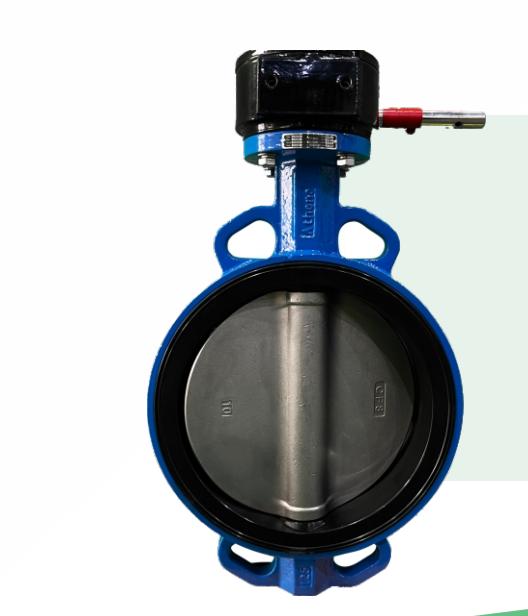
A butterfly valve is a rotary valve that opens and closes by means of a 90° or nearly 90° rotation of a disc-shaped closure member (circular or rectangular). It primarily consists of a valve body, disc, stem, and handle/actuator.
Applications
Butterfly valves are widely used in municipal water supply and drainage systems, and also play a critical role in thermal power plants, nuclear power plants, sewage treatment plants, and other industrial fields. In addition, large-scale water turbines in hydropower stations often adopt butterfly valve designs as inlet valves.
They are suitable for a wide range of media, including gases such as coal gas and steam, dry powders, slurries, as well as liquids such as water, condensate, sewage, and seawater.
Butterfly valves are widely used in municipal water supply and drainage systems, and also play a critical role in thermal power plants, nuclear power plants, sewage treatment plants, and other industrial fields. In addition, large-scale water turbines in hydropower stations often adopt butterfly valve designs as inlet valves.
They are suitable for a wide range of media, including gases such as coal gas and steam, dry powders, slurries, as well as liquids such as water, condensate, sewage, and seawater.
Classifications
Butterfly valves can be categorized according to different criteria:
*By function:shut-off type and modulating/regulating type.
*By structural design: concentric (centerline), single-eccentric, double-eccentric, and triple-eccentric types.
*By sealing material: rubber-sealed, PTFE-sealed, and metal-sealed models.
Concentric (Centerline) Butterfly Valve
In a concentric butterfly valve, the stem axis lies in the same plane as the center plane of the disc and intersects the pipeline centerline at a right angle. This design creates a symmetrical disc area on both sides of the stem axis, simplifying the structure and achieving bidirectional symmetrical sealing. It also features low flow resistance and relatively low operating torque, making it widely used in medium and small-sized butterfly valves.
However, it has drawbacks: the stem ends are subject to constant friction, leading to faster wear and potential leakage. To mitigate this, PTFE liners are sometimes used to reduce friction, or springs are added to compensate for wear. Notably, if a metal-to-metal seal is employed, the sealing performance of the concentric type may be compromised.
In a concentric butterfly valve, the stem axis lies in the same plane as the center plane of the disc and intersects the pipeline centerline at a right angle. This design creates a symmetrical disc area on both sides of the stem axis, simplifying the structure and achieving bidirectional symmetrical sealing. It also features low flow resistance and relatively low operating torque, making it widely used in medium and small-sized butterfly valves.
However, it has drawbacks: the stem ends are subject to constant friction, leading to faster wear and potential leakage. To mitigate this, PTFE liners are sometimes used to reduce friction, or springs are added to compensate for wear. Notably, if a metal-to-metal seal is employed, the sealing performance of the concentric type may be compromised.
Double-Eccentric Butterfly Valve
To overcome the limitations of single-eccentric designs, the double-eccentric butterfly valve offsets the valve shaft by a distance e, creating an obtuse angle (greater than 90°) between the line connecting the shaft center to the sealing point and the sealing face. This eliminates sealing interference and ensures that the sealing force increases gradually during closing, delivering more reliable sealing.
When opening, the disc’s sealing face quickly disengages from the seat, greatly reducing scuffing and wear. This design also enables the use of metal hard seals.
A design challenge is that preventing cone-on-cone metal hard seal interference may require an additional secondary eccentricity, which increases the opening torque. This led to the development of the triple-eccentric butterfly valve.

Triple-Eccentric Butterfly Valve
The triple-eccentric design further optimizes the double-eccentric structure by rotating the conical angle to an oblique cone, effectively reducing the eccentricity e and thus lowering the opening torque. However, this introduces new complexities: the shaft placement requires three-dimensional kinematic analysis to avoid interference between the sealing pairs, demanding precise calculations and a deep understanding of the valve’s operating principles.

Key Characteristics of Butterfly Valves
Butterfly valves are known for their simple structure and compact dimensions, making them ideal for quick opening and closing operations. They have a short face-to-face length, low fluid resistance, and excellent flow control properties. Additionally, they require relatively low operating torque, enhancing ease of use.
These strengths make them particularly well-suited for low-pressure, large-diameter applications, where they can serve as both shut-off and regulating valves. However, due to their common reliance on soft seals, butterfly valves are not suitable for high-temperature, high-pressure environments.
 How Does a Ball Type Check Valve Prevent Pipeline Medium Backflow?
  Selection and Precautions for Natural Gas Valves
  Athena Engineering S.R.L Wraps‑up OGA 2026 Kuala Lumpur
  What is a Gate Valve? What is Its Working Principle?
  T-Type / T-Pattern / Straight Pattern Globe Valve
  Knife Gate Valve vs Wedge Gate Valve: Which Is Better for Your Industrial Piping?
  Cryogenic Ball Valve Comprehensive Product Overview
  Causes and Treatments for Poor Valve Shut‑Off
  Athena Triple Offset Butterfly Valves
  What is the Difference Between Swing Check Valve and NRV? A Complete Explanation
  Common Connection Types of Valves
  5 Piping Design Mistakes That Are Killing Your Valves
  Float Valve: Structure, Principle and Application
  High Pressure Needle Valve High-Precision Fluid Control Valve
  What is a Piston Check Valve?
  Meet Us at OGA 2026 | Booth 6802, Hall 6
  What is a Level Gauge? Working Principles, Types and Industrial Applications
  Double Sealing Protection: A Complete Interpretation of Bellows Globe Valves
  End-Suction Pump vs Inline Pumps: Which One Is Right for You?
  Method of Selecting Valve Types Based on Throttling Degree