
What is Axial Flow Check Valve? (An Introduction)
author: ATHENA GROUP
2023-10-17
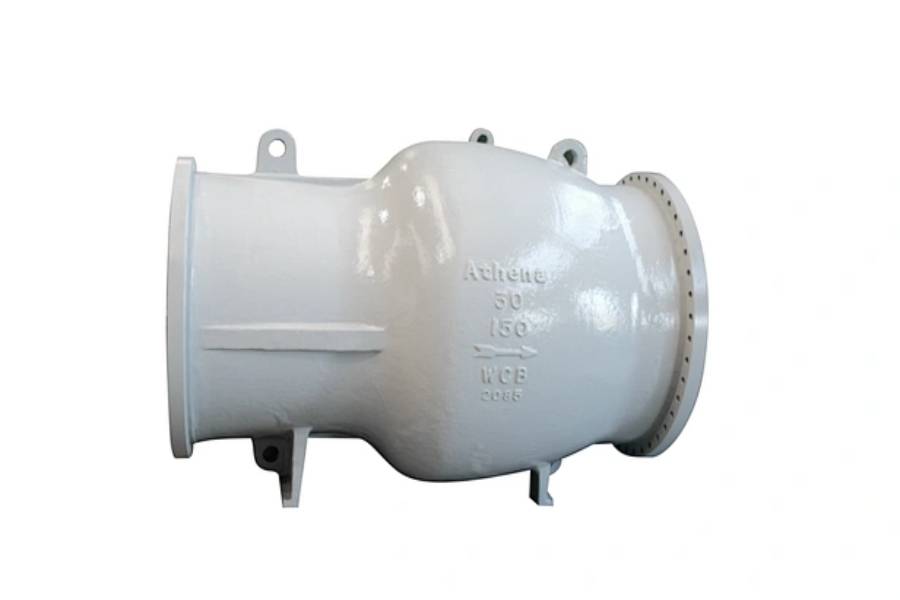
A wide range of industries use pumps and compressors, including pharmaceuticals, food and beverages, petrochemicals, natural gas, power generation, chemical industries, and building maintenance. Compressors and pumps transport fluids from one place to another, respectively.
Pumps and compressors benefit greatly from axial flow check valves, which induce flow in one direction while preventing backflow in the opposite direction. In order to protect your investment, axial flow check valves are critical to prevent backward flow from causing extensive damage.
Pumps and compressors benefit greatly from axial flow check valves, which induce flow in one direction while preventing backflow in the opposite direction. In order to protect your investment, axial flow check valves are critical to prevent backward flow from causing extensive damage.
Definition and Overview of Axial Flow Check Valves
An axial disc check valve prevents rapid reverse flow from a pipe, known as "water hammer," which can damage pipe system equipment severely. A valve of this type closes quickly enough to prevent slamming without excess spikes.
Spring assisted axial flow check valve features contribute to its non-slam closing and low maintenance. Its streamlined design allows it to be fully opened at low flows and flow rates.
Under normal flow conditions, the disc remains positioned against its backstop due to the Venturi effect, allowing a rapid full opening. When the flow is reduced, the spring quickly overcomes the fluid force, turning the disc back into a full close position. With a slam-free response, this system protects critical pipeline elements by significantly reducing the reaction time.
There are many applications for these kinds of valves, including oil & gas, petrochemical, power generation, chemical... They are used in any process where water hammering is an issue. They're an alternative to Quick Closing Non Return Valves assisted by actuators and used in systems with higher protection requirements.
Spring assisted axial flow check valve features contribute to its non-slam closing and low maintenance. Its streamlined design allows it to be fully opened at low flows and flow rates.
Under normal flow conditions, the disc remains positioned against its backstop due to the Venturi effect, allowing a rapid full opening. When the flow is reduced, the spring quickly overcomes the fluid force, turning the disc back into a full close position. With a slam-free response, this system protects critical pipeline elements by significantly reducing the reaction time.
There are many applications for these kinds of valves, including oil & gas, petrochemical, power generation, chemical... They are used in any process where water hammering is an issue. They're an alternative to Quick Closing Non Return Valves assisted by actuators and used in systems with higher protection requirements.
Why Is a Non-slam Check Valve Used?
When the flow reverses within a pipe, it may result in hydraulic shock waves, commonly known as water hammer, which can potentially lead to significant equipment damage within the pipeline if preventive measures are not implemented. To mitigate this risk, the introduction of the appropriate check valve, fully closed during reverse flow, serves as an effective preventive measure, averting potential site issues.
Check valves designed to prevent water hammer and close swiftly without slamming are commonly referred to as non-slam check valves.
Check valves designed to prevent water hammer and close swiftly without slamming are commonly referred to as non-slam check valves.
Types of Axial Flow Check Valves
Axial flow check valves come in various types, each designed to suit specific applications and operating conditions. The main types of axial flow check valves include:
1.Swing Type Axial Flow Check Valves:
Operation: Swing check valves have a hinged disc that swings open to allow forward flow and swings closed to prevent backflow. The swinging disc is typically free-moving, relying on gravity and fluid pressure to function.
Applications: Commonly used in water and wastewater systems, as well as general-purpose applications where low-pressure drop is acceptable.
Applications: Commonly used in water and wastewater systems, as well as general-purpose applications where low-pressure drop is acceptable.
2.Spring-Loaded Axial Flow Check Valves:
Operation: These valves incorporate a spring mechanism to ensure the check valve closes rapidly when reverse flow occurs. The spring helps prevent water hammer and ensures a quick response to flow changes.
Applications: Suitable for applications where rapid closing is essential to prevent water hammer, such as in pump discharge lines.
Applications: Suitable for applications where rapid closing is essential to prevent water hammer, such as in pump discharge lines.
Operation: Dual plate check valves have two hinged discs that swing open during forward flow and close during reverse flow. They are typically smaller and lighter than swing check valves, providing reduced pressure drop.
Applications: Commonly used in high-pressure and high-temperature applications, such as the oil and gas industry.
Applications: Commonly used in high-pressure and high-temperature applications, such as the oil and gas industry.
4.Nozzle Type Axial Flow Check Valves:
Operation: Nozzle check valves use a nozzle and a spring-loaded disc to control the flow of fluid. When reverse flow occurs, the disc is pushed against the nozzle, blocking the flow.
Applications: Used in various industries, including chemical processing and HVAC systems, where the prevention of reverse flow and water hammer is essential.
Applications: Used in various industries, including chemical processing and HVAC systems, where the prevention of reverse flow and water hammer is essential.
5.Piston Type Axial Flow Check Valves:
Operation: Piston check valves utilize a piston-like element to control the flow. When reverse flow occurs, the piston moves to close the valve, preventing backflow.
Applications: Suitable for high-pressure and high-temperature applications, including the oil and gas industry.
Applications: Suitable for high-pressure and high-temperature applications, including the oil and gas industry.
6.Stop Check Valves:
Operation: Stop check valves function as a combination of a globe valve and a check valve. They can be used to control flow in both directions, with a handwheel or actuator to open or close the valve manually.
Applications: Found in applications where flow control and isolation are required, such as steam systems and power generation.
Applications: Found in applications where flow control and isolation are required, such as steam systems and power generation.
7.Inline or Axial Spring Check Valves:
Operation: These valves feature a spring-loaded design that allows them to open when forward flow is desired and close when backflow occurs, offering protection against water hammer.
Applications: Used in various industries, including HVAC, chemical processing, and water distribution systems.
Applications: Used in various industries, including HVAC, chemical processing, and water distribution systems.
Advantages of Using Axial Flow Check Valves
Axial flow check valves provide several advantages when compared to other check valve types, including:
- Swift Closing Action: They can rapidly close, effectively preventing water hammering and associated damage.
- Tailored Sizing: These valves can be accurately sized for each specific application, optimizing their performance.
- Durability: Axial flow check valves are known for their robust construction, ensuring long-lasting performance.
- Extended Lifespan: Their durability contributes to an increased valve longevity, reducing maintenance and replacement costs.
- Low-Pressure Drop and High Flow Capacity: These valves can handle high flow rates while maintaining low-pressure drops, promoting efficient fluid system operation.
- Non-Slam Operation: They open and close without slamming, reducing wear and tear on the valve and system components.
- Tight Seal: Axial flow check valves provide a tight shut-off, minimizing leakage and enhancing system integrity.
- Versatile End-to-End Options: They offer various end-to-end connection options, making them adaptable to different piping configurations.
- Flexible Installation: These valves can be installed in both horizontal and vertical orientations, accommodating diverse system designs and requirements.
In summary, axial flow check valves deliver a range of benefits, including rapid closing, tailored sizing, durability, extended lifespan, efficient flow management, non-slam operation, tight sealing, adaptability, and flexible installation, making them a preferred choice in various fluid control applications.
Applications of Axial Flow Check Valves
Although axial flow check valves can be utilized in a multitude of applications, a growing number of niche sectors the valves have primarily been utilized in the following:
Chemical and pharma:
- Chlorine
- Phosgene
- Aromatics
- Polymers
- Acids
- Air separation
- Caustics
Oil and gas production, including midstream:
- Regasification
- Liquefaction
- Centrifugal compressor discharge
- Fire water lines
- Oil/steam separation
- Steam and CO₂ injection
- Oil and gas gathering systems
Power:
- Steam
- Condensate
- Boiler feed pumps
- Cooling towers
- Service water recirculators
- River water intake
- Renewables
Petroleum refining and petrochemicals:
- Hydrogen
- Cracking
- Steam
- Crude oil
- Ethylene
- Propylene
- Steam
The most important thing to remember is that axial flow check valves are specifically designed for fast-reversing systems where backflow is a constant concern.
Best Axial Check Valve Manufacturer
Athena manufactures valves using verified and guaranteed raw materials, backed by material test certificates and hydraulic test certificates, all accompanied by MTC 3.1 documentation for every supply. Furthermore, we offer the option of third-party inspection services.
For more detailed information on our axial flow check valves, please explore our comprehensive online technical catalog. To discuss your specific requirements with one of our valve experts at Athenavalve, feel free to contact us, or you can request a quote today!
 How Does a Ball Type Check Valve Prevent Pipeline Medium Backflow?
  Selection and Precautions for Natural Gas Valves
  Athena Engineering S.R.L Wraps‑up OGA 2026 Kuala Lumpur
  What is a Gate Valve? What is Its Working Principle?
  T-Type / T-Pattern / Straight Pattern Globe Valve
  Knife Gate Valve vs Wedge Gate Valve: Which Is Better for Your Industrial Piping?
  Cryogenic Ball Valve Comprehensive Product Overview
  Causes and Treatments for Poor Valve Shut‑Off
  Athena Triple Offset Butterfly Valves
  What is the Difference Between Swing Check Valve and NRV? A Complete Explanation
  Common Connection Types of Valves
  5 Piping Design Mistakes That Are Killing Your Valves
  Float Valve: Structure, Principle and Application
  High Pressure Needle Valve High-Precision Fluid Control Valve
  What is a Piston Check Valve?
  Meet Us at OGA 2026 | Booth 6802, Hall 6
  What is a Level Gauge? Working Principles, Types and Industrial Applications
  Double Sealing Protection: A Complete Interpretation of Bellows Globe Valves
  End-Suction Pump vs Inline Pumps: Which One Is Right for You?
  Method of Selecting Valve Types Based on Throttling Degree