
What is a Hard-sealed Ball Valve?
author: ATHENA GROUP
2026-04-14
The hard-sealed ball valve is an industrial valve that employs a metal-to-metal sealing pair. It is mainly used for fluid control in fields such as petroleum, natural gas, chemical engineering, and power generation, and is suitable for harsh working conditions including high-temperature, high-pressure water, steam, dust, and corrosive media. Its structure is divided into floating ball type and fixed ball type. It can be connected by flange, welding, or thread. The sealing direction includes one-way and two-way. The valve body and sealing surface achieve high hardness through spraying or hardening processes.

I.Classification
Hard-sealed ball valves can be classified based on different dimensions, mainly including sealing direction, structural form, connection form, specific working conditions and functions, as well as driving methods.
According to the sealing direction, they can be divided into single-direction sealing and double-direction sealing. The single-direction sealing can only seal in the specified direction, which is the sealing direction indicated on the ball valve, while the double-direction sealing can seal in both directions.
The structural forms mainly include floating ball type and fixed ball type.
The connection forms include flange connection, welding connection and threaded connection, and there is also flange connection.
According to specific working conditions and functions, they can be classified as large-diameter hard-sealed fixed ball valves, ultra-high-pressure hard-sealed ball valves, high-temperature hard-sealed ball valves (if the applicable temperature is ≤ 350℃), hard-sealed three-way ball valves, hard-sealed eccentric hemispherical valves, insulated jacket hard-sealed ball valves, and blow-off type bellows hard-sealed ball valves, etc.
The driving methods include manual, worm gear transmission, pneumatic or electric. The actuator of the electric hard-sealed ball valve can have a built-in servo system.
II.Structural Characteristics
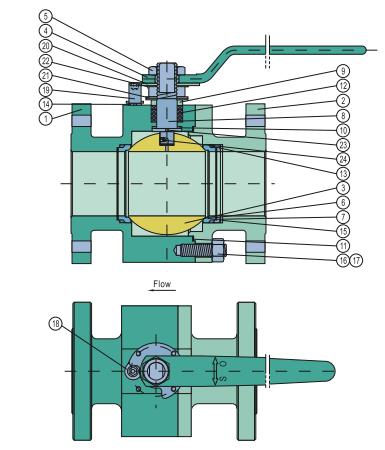
- Component composition: It is mainly composed of the valve body, valve cover, ball, valve seat, valve stem, sealing components, and handwheel and other accessories.
- Ball characteristics: The ball is the core component, usually made of materials such as stainless steel, carbon steel, chromium-molybdenum steel, etc., with high mechanical strength and corrosion resistance. The surface of the ball is treated with special processes such as polishing, nitriding, hardfacing, and spraying to increase surface hardness and smoothness, ensuring good sealing performance.
- Valve seat design: The valve seat is usually made of metal materials or hard alloys that match the ball, and some also use non-metal materials such as polytetrafluoroethylene and carbon fiber reinforced polyimide. The structural design of the valve seat is reasonable, and common types include spring-loaded type and plate spring-loaded type, ensuring close contact with the ball under different working conditions.
- Connection method: The connection forms are diverse, including flange connection, welding connection, and threaded connection, facilitating installation and disassembly with the pipeline system.
- Drive method: It can adopt various drive methods such as manual, pneumatic, and electric, to meet different usage requirements.
III.Working Principle Characteristics
- Rotary seal principle: The valve is opened and closed by the 90° rotation of the ball around the centerline of the valve body. When the channel of the ball aligns with the pipeline, the valve is in the open state, and the fluid can flow smoothly; when the ball rotates 90°, the channel is blocked by the ball, and the valve is in the closed state, with the surface of the ball tightly adhering to the valve seat, preventing the flow of the fluid.
- Sealing force formation: The seal is formed by the pre-set preload force between the ball and the valve seat, combined with the force of the fluid pressure acting on the sealing surface of the valve seat. The preload force is generally achieved by setting elastic elements such as disc springs or cylindrical springs between the valve seat and the valve body.
- Wide adaptability to working conditions: Due to the use of a metal-to-metal hard sealing structure, the hard-sealed ball valve has the characteristics of high temperature resistance, high pressure resistance, wear resistance, and corrosion resistance, and is suitable for various harsh working conditions, such as high-temperature steam, corrosive liquids, and media containing particles.
- Convenient and flexible operation: Opening and closing are rapid, only requiring a 90° rotation to achieve. The operation is simple, and the flow resistance is small. When fully open or fully closed, the sealing surfaces of the ball and the valve seat are isolated from the medium, and the medium passing through will not cause erosion of the valve sealing surfaces.
- Bidirectional sealing function: Some hard-sealed ball valves have a bidirectional sealing function, which can effectively seal in both directions, improving the flexibility and safety of the valve's use.
 How Does a Ball Type Check Valve Prevent Pipeline Medium Backflow?
  Selection and Precautions for Natural Gas Valves
  Athena Engineering S.R.L Wraps‑up OGA 2026 Kuala Lumpur
  What is a Gate Valve? What is Its Working Principle?
  T-Type / T-Pattern / Straight Pattern Globe Valve
  Knife Gate Valve vs Wedge Gate Valve: Which Is Better for Your Industrial Piping?
  Cryogenic Ball Valve Comprehensive Product Overview
  Causes and Treatments for Poor Valve Shut‑Off
  Athena Triple Offset Butterfly Valves
  What is the Difference Between Swing Check Valve and NRV? A Complete Explanation
  Common Connection Types of Valves
  5 Piping Design Mistakes That Are Killing Your Valves
  Float Valve: Structure, Principle and Application
  High Pressure Needle Valve High-Precision Fluid Control Valve
  What is a Piston Check Valve?
  Meet Us at OGA 2026 | Booth 6802, Hall 6
  What is a Level Gauge? Working Principles, Types and Industrial Applications
  Double Sealing Protection: A Complete Interpretation of Bellows Globe Valves
  End-Suction Pump vs Inline Pumps: Which One Is Right for You?
  Method of Selecting Valve Types Based on Throttling Degree