
Eccentric Butterfly Valve Design and Sealing Performance Analysis
author: ATHENA GROUP
2026-02-06
A butterfly valve is a type of valve used to regulate and shut off fluid in a pipeline. Its structural characteristics include a small valve body diameter, thin walls, and light weight. The valve's closing mechanism is a large butterfly-shaped disc that can rotate back and forth within the valve's pipe channel, enabling opening and closing functions. The shape of the butterfly plate resembles a butterfly-shaped disc, hence the name 'butterfly valve'.

1.Introduction to Butterfly Valves
As early as the 4th century BC, the ancient Greeks had begun using simple butterfly valves. These valves were made of a pair of metal plates used to control water flow. At that time, this type of valve was called a 'butterfly valve,' meaning a valve that 'flutters like a butterfly.' With the advancement of technology and industrial development, the structure and materials of butterfly valves have been continuously improved and are now widely used in various fields.
The butterfly valve gets its name mainly because its structure and shape are similar to a butterfly. This type of valve has a butterfly-like appearance and dynamic characteristics. Over time, the term 'butterfly valve' gradually evolved into the current 'butterfly valve.' In addition, butterfly valves have a simple structure, are easy to use, and have good sealing performance, which is why they are widely used in various situations.
A standard butterfly valve consists of the following components:
Body: Serves as the outer shell of the valve, providing fluid passage and a mounting base. The material is chosen according to the characteristics of the medium (such as cast iron, stainless steel, etc.).
- Disc: The core moving component, shaped like a disc, controls the flow and shutoff of the fluid through rotation. The material and sealing structure affect its performance.
- Stem: Connects the disc to the actuator, transmitting torque to rotate the disc. It must have sufficient strength and corrosion resistance.
- Seat: Installed on the inner diameter of the valve body or the outer edge of the disc, forming a seal with the disc. Materials include rubber, PTFE, metal, etc.
- Actuator: Includes manual (handwheel, worm gear), electric, pneumatic, and hydraulic types, enabling remote or automatic control.
- Packing and Sealing Assembly: Prevents leaks between the stem and the valve body, consisting of a packing gland and packing material.
- Bearing/Bushing: Supports the stem, reduces rotational friction, and ensures smooth disc rotation.

2.Classification of Butterfly Valves
2.1 Sealing Type
Butterfly valve sealing types can be divided into soft-sealed butterfly valves and hard-sealed butterfly valves.
2.1.1 Soft-seated Butterfly Valve
A soft-sealed butterfly valve refers to a valve where one side of the sealing pair is made of metal material and the other side is made of elastic non-metallic material. This type of seal has good sealing performance, but it is not resistant to high temperatures, prone to wear, and mechanically weaker. The valve seat materials for soft-sealed butterfly valves include two types of rubber, EPDM and NBR, as well as PTFE fluoroplastic. These three materials give soft-sealed butterfly valves excellent sealing performance, but due to the inherent limitations of the materials, soft-sealed butterfly valves cannot be used in high-temperature or high-pressure environments. In addition, the erosion resistance of the sealing surface material of soft-sealed butterfly valves is not as good as that of metal materials, so their service life is relatively shorter compared to hard-sealed butterfly valves.
2.1.2 Hard-seated Butterfly Valve
A hard-seal butterfly valve refers to a valve where both sides of the sealing pair are made of metal or other relatively hard materials. This type of seal has relatively poor sealing performance, but it is resistant to high temperatures, wear-resistant, and has good mechanical properties. A hard-seal butterfly valve uses a circular disc (the sealing component) that rotates with the valve shaft to open or close the pipeline, primarily serving as a shut-off valve, but it can also be designed to provide both shut-off and throttling functions. The use of hard-seal butterfly valves is increasing in low-pressure, medium- and large-diameter pipelines. The butterfly disc of the hard-seal butterfly valve is installed along the diameter of the pipeline. Inside the cylindrical passage of the valve body, the disc-shaped butterfly rotates around an axis with an angle ranging from 0° to 90°; when rotated to 90°, the valve is fully open. The sealing butterfly valve has a simple structure, small size, and light weight, consisting of only a few parts. It can be quickly opened or closed with just a 90° rotation, making it easy to operate. Additionally, this electric valve has good fluid control characteristics. When the butterfly valve is fully open, the thickness of the disc is the main resistance to the medium flowing through the valve body, so the pressure drop generated by the valve is very small, giving it good flow control characteristics.
2.2 Eccentric Structure
Soft-sealed butterfly valves are mostly concentric type butterfly valves, while hard-sealed ones are mostly single-eccentric, double-eccentric, or triple-eccentric butterfly valves.
2.2.1 Single-eccentric Butterfly Valve
The design feature of a centric butterfly valve lies in the coaxial alignment of the valve stem axis, the center of the disc, and the valve body center. Its structure is simple and easy to manufacture. However, this type of valve has a drawback: the disc is continuously subjected to squeezing and scraping against the valve seat, which increases resistance and accelerates wear. To ensure sealing performance and reduce squeezing and scraping, the valve seat is usually made of EPDM material, while for special operating conditions, PTFE material is used.

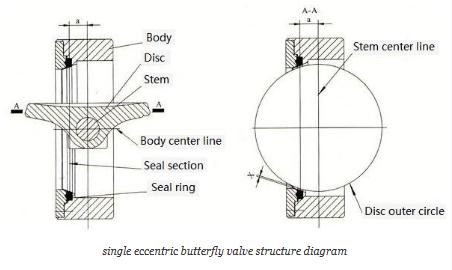
To solve the issue of the disc being pressed against the valve seat in concentric butterfly valves, the single-eccentric butterfly valve was developed. The structural feature of this valve is that there is an offset between the stem axis and the center of the disc, causing the top and bottom ends of the disc to no longer serve as the rotation axis, thereby dispersing and reducing the excessive compression between the top and bottom ends of the disc and the valve seat.
2.2.2 Double-eccentric Butterfly Valve
The double-eccentric butterfly valve is a further improvement based on the single-eccentric butterfly valve. The valve stem axis does not completely coincide with the center of the disc, nor with the center of the body. The double-eccentric design allows the disc to quickly move away from the seat during the opening process, significantly reducing unnecessary excessive squeezing and scraping between the disc and the seat, lowering the opening resistance, reducing wear, and thereby extending the service life of the valve seat. With scraping greatly reduced, double-eccentric butterfly valves can use metal seats, enhancing their performance in high-temperature environments. Its sealing principle is a contact sealing structure, meaning the sealing surfaces of the disc and the seat are in line contact. The seal is achieved through elastic deformation caused by the disc pressing against the seat, therefore requiring high precision in the closed position (especially for metal seats) and having relatively low pressure-bearing capacity. This is why, according to traditional views, butterfly valves are considered unsuitable for high pressure and prone to leakage.

2.2.3 Triple-eccentric Butterfly Valve
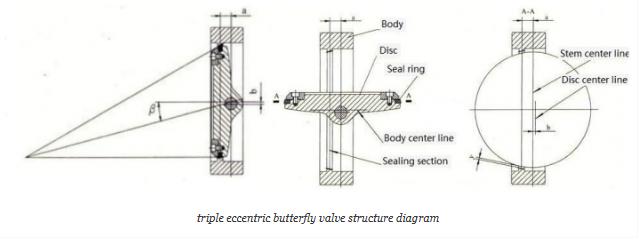
The meaning of the three eccentric butterfly valves is to do eccentricity for the butterfly valve three times:
The first eccentricity: the shaft deviates from the centerline of the sealing surface
The second eccentricity: the shaft deviates from the pipeline and the center line of the valve
The third eccentricity: its unique eccentric valve seat angle and the angle between the center of the pipeline, so that the valve seat and the sealing ring are completely separated during the whole valve opening and closing process. This structure utilizes both the cam effect and completely eliminates friction, eliminating the possibility of wear and leakage
This design process allows the three-eccentric butterfly valve to have a wider range of applications, which not only has the good sealing performance of the soft-sealed butterfly valve, but also has the characteristics of high-temperature and high-pressure resistance of the hard-sealed butterfly valve. According to the different characteristics of high and low temperature sealing materials, hard sealing materials are more suitable for high-temperature environments, while soft sealing materials are more suitable for achieving zero leakage. In order to solve the contradiction between high temperature and zero leakage of double eccentric butterfly valves, engineers conducted a third eccentric design of butterfly valves after in-depth research. The structural feature of this three-eccentric butterfly valve is that on the basis of the double eccentric valve stem and shaft, the position of the conical axis of the butterfly plate sealing surface relative to the cylindrical axis of the body is further adjusted. After careful design, the butterfly plate sealing section of the three-eccentric butterfly valve changes from round to oval, thus achieving the asymmetry of the sealing surface shape. One side is parallel to the center line of the body, and the other side is inclined to the center line of the body. This structural optimization allows the triple eccentric butterfly valve to maintain excellent sealing performance in high-temperature environments while achieving zero leakage requirements.
2.3 Connection Types
Butterfly valves determine the installation method of the pipeline according to the type of connection, adapting to different pipeline project requirements.
2.3.1 Wafer connection
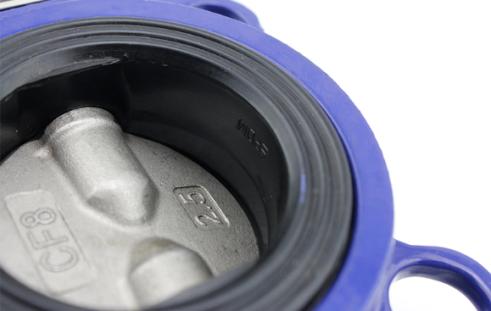
Wafer connections are one of the most classic and widely used connection methods for butterfly valves. As the name suggests, it involves 'clamping' the valve disc of the butterfly valve between two pipe flanges and then securing it by bolts passing through the connection holes of the flanges and the butterfly valve.
2.3.2 Flanged Connection
As the name suggests, a flanged butterfly valve achieves sealing by closely fitting the flange with the pipe flange and then securing it with bolts. The advantages of this type of connection are very prominent.

2.3.3 lug connection
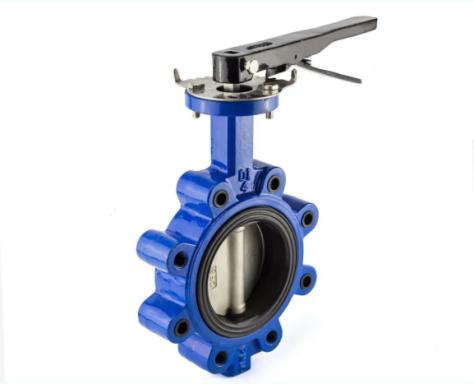
LT lug connections are an "exclusive custom feature" for large-diameter butterfly valves, specifically designed for high-flow pipelines with DN300 and above. The core idea is to add integrated lugs (lug shafts) at both ends or in the middle of the valve body, which are fixed to the pipeline support or special flanges through the positioning holes on the lugs, effectively adding a "load-bearing frame" to the valve.
2.3.4 Clamp connection
Clamp connection is representative of the 'quick-install' style. The valve is secured to the pipeline using a clamp and tightening bolts, featuring easy installation and convenient disassembly.

2.3.5 Welded connection
Welded connections involve directly welding the inlet and outlet ends of the butterfly valve to the pipeline, making the valve and pipeline 'integrated as one.' This method serves as a 'guardian' for high-risk media.

3.Conclusion
In the future, with the development trends of industrial intelligence and greening, butterfly valve technology will continue to advance toward intelligent control and high-efficiency energy saving. New butterfly valves, which combine precise control capability with long-term stability, will undoubtedly play an increasingly critical role in modern industrial systems, providing more reliable solutions for various fluid transport and pipeline control.
 How Does a Ball Type Check Valve Prevent Pipeline Medium Backflow?
  Selection and Precautions for Natural Gas Valves
  Athena Engineering S.R.L Wraps‑up OGA 2026 Kuala Lumpur
  What is a Gate Valve? What is Its Working Principle?
  T-Type / T-Pattern / Straight Pattern Globe Valve
  Knife Gate Valve vs Wedge Gate Valve: Which Is Better for Your Industrial Piping?
  Cryogenic Ball Valve Comprehensive Product Overview
  Causes and Treatments for Poor Valve Shut‑Off
  Athena Triple Offset Butterfly Valves
  What is the Difference Between Swing Check Valve and NRV? A Complete Explanation
  Common Connection Types of Valves
  5 Piping Design Mistakes That Are Killing Your Valves
  Float Valve: Structure, Principle and Application
  High Pressure Needle Valve High-Precision Fluid Control Valve
  What is a Piston Check Valve?
  Meet Us at OGA 2026 | Booth 6802, Hall 6
  What is a Level Gauge? Working Principles, Types and Industrial Applications
  Double Sealing Protection: A Complete Interpretation of Bellows Globe Valves
  End-Suction Pump vs Inline Pumps: Which One Is Right for You?
  Method of Selecting Valve Types Based on Throttling Degree