
Comprehensive Introduction to Ball Valves: Structure, Principle and Applications
author: ATHENA GROUP
2026-01-30
This article will comprehensively introduce the core structure, working mechanism, classification, advantages, and disadvantages of ball valves, and sort out their wide applications in industrial fields.
Table of Contents
1.History of Ball Valves
2.Basic Structure of Ball Valves
3.Working Principle of Ball Valves
4.Classification of Ball Valves
5.Advantages and Disadvantages of Ball Valves
6.Future Outlook of Ball Valves
1.History of Ball Valves
The origin of ball valves can be traced back to the 19th century. At that time, John Wallen and John Charpmen designed the spherical plug valve, the prototype of the modern ball valve, but it was not put into mass production then.
With the advancement of the Industrial Revolution, ball valve technology has been continuously improved. Since the formal invention of ball valves in the 1950s, they have become a reliable fluid control device in industrial manufacturing.
Their low maintenance cost is one of the key factors for the continuous growth of their usage, providing an efficient solution for modern industrial fluid control.
2.Basic Structure of Ball Valves
A ball valve takes its name from its core component, the spherical valve element with a central through-hole. A standard ball valve is composed of the following key parts:
- Valve Body: It is the main pressure-bearing structure of the ball valve, usually made of stainless steel, carbon steel, brass and other durable materials.
- Ball: As the core control component, the surface is designed with a through-hole. Modern ball valves generally use polished stainless steel to make the ball to ensure smooth rotation and good sealing.
- Valve Seat: It is usually made of PTFE, nylon and other reinforced polymer materials, which is crucial for the sealing performance of the ball valve.
- Valve Stem: It connects the ball and the external control mechanism, and transmits the external torque to the ball to drive its rotation.
- Seals and Packing: It is used to prevent fluid leakage along the valve stem and at the connection of the valve body.
- Handle or Actuator: It is responsible for manual or automatic control of the opening and closing of the ball valve.

3.Working Principle of Ball Valves
The working principle of the ball valve is based on the rotation of the spherical valve element. The valve stem drives the ball to rotate around the axis perpendicular to the pipeline, thereby controlling the on-off of the medium flow.
- Opening State: When the through-hole of the ball is rotated to be parallel to the pipeline axis, the medium can flow through the ball valve smoothly.
- Closing State: When the ball is rotated 90°, the through-hole is perpendicular to the pipeline axis. At this time, the ball fits tightly with the valve seat to cut off the medium flow.


4.Classification of Ball Valves
Ball valves can be divided into different types according to multiple classification criteria, to meet the needs of different application scenarios.
Classification by Driving Method
- Manual Ball Valve: It is operated manually through the handle, which is suitable for scenarios with low automation requirements.
- Pneumatic Ball Valve: It uses air pressure as the power source to drive the valve to open and close, with fast response speed.
- Electric Ball Valve: It is driven by an electric actuator, which is suitable for remote control and automated system integration.
Classification by Structural Form
1.Classification by the Number of Components:
- One-piece ball valve: The structure is integrated, with good sealing performance.
- Two-piece ball valve: It is composed of two main parts, which is convenient for installation and maintenance.
- Three-piece ball valve: It is divided into three parts, and the internal parts can be replaced without removing the entire valve from the pipeline.
2.Classification by Connection Method:
- Split-type ball valve: Easy to disassemble and maintain.
- Top-entry ball valve: The internal components can be maintained from the top without disconnecting the pipeline.
- Welded ball valve: It is connected to the pipeline by welding, with good sealing and high pressure resistance.
3.Classification by Ball Structure:
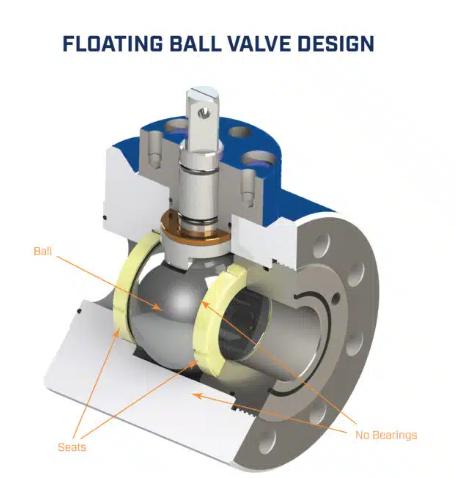
- Floating Ball Valve: The ball is in a floating state without rigid connection with the valve body. When the valve is closed, the upstream medium pressure pushes the ball to press against the downstream valve seat to realize sealing. It has the advantages of simple structure, low manufacturing cost and convenient maintenance, but it is only suitable for low-pressure and small-diameter scenarios, and many models only support unidirectional flow.
- Trunnion Ball Valve: The ball is fixed by upper and lower valve stems and bearings, with no displacement space inside the valve body. It is equipped with a floating valve seat, which realizes sealing through the combined action of spring preload and medium pressure. It has strong pressure resistance, stable sealing performance, smooth operation and high functional expandability, but the structure is complex, and the manufacturing and maintenance costs are high.
4.Classification by Bore Size:
- Full Bore Ball Valve: The diameter of the through-hole of the ball is the same as the inner diameter of the pipeline, with minimal fluid resistance and unobstructed flow, which can reduce energy loss during medium transportation.
- Reduced Bore Ball Valve: The diameter of the through-hole of the ball is smaller than the inner diameter of the pipeline, resulting in a smaller flow area and slight pressure loss, but it has the advantages of compact structure and low cost.
5.Advantages and Disadvantages of Ball Valves
Advantages
- Simple Structure and Easy Maintenance: The number of components is small, the structure is straightforward, and the seals are usually movable, which is convenient for disassembly and replacement.
- Compact Size and Light Weight: It occupies less installation space and is easy to install and handle, reducing the labor and material costs during the installation process.
- Low Fluid Resistance: Especially for full-bore ball valves, the fluid resistance is almost zero, which can minimize energy loss in long-distance pipeline transportation systems and reduce pumping costs.
- Fast Opening and Closing: The opening and closing can be completed by rotating 90°, and the opening and closing time of some designs is only 0.05-0.1 seconds, which can quickly respond to the control requirements of the system and is suitable for automated systems.
- Good Sealing Performance: The seals are mostly made of plastic materials with a low friction coefficient, which can achieve excellent sealing effects, and is widely used in vacuum systems such as high-demand electronic manufacturing industries.
- Long Service Life: When fully open or fully closed, the sealing surface between the ball and the valve seat is isolated from the medium, avoiding erosion by the medium and extending the service life of the valve.
- Wide Application Range: The nominal diameter ranges from a few millimeters to several meters, and it can be used in environments from high vacuum to high pressure.
Disadvantages
The manufacturing and grinding process of the spherical valve element is difficult. The special spherical shape requires high precision and surface finish, and needs to use specialized equipment and techniques, which increases the production cost of the ball valve.
The manufacturing and grinding process of the spherical valve element is difficult. The special spherical shape requires high precision and surface finish, and needs to use specialized equipment and techniques, which increases the production cost of the ball valve.
6.Future Outlook of Ball Valves
As an important fluid control device, ball valves will have a broad development prospect with the continuous advancement of technology and the continuous expansion of the industrial sector. The future development direction will focus on improving manufacturing precision, reducing production costs, and enhancing the adaptability and intelligent level of ball valves to meet the increasingly complex industrial fluid control needs.
 How Does a Ball Type Check Valve Prevent Pipeline Medium Backflow?
  Selection and Precautions for Natural Gas Valves
  Athena Engineering S.R.L Wraps‑up OGA 2026 Kuala Lumpur
  What is a Gate Valve? What is Its Working Principle?
  T-Type / T-Pattern / Straight Pattern Globe Valve
  Knife Gate Valve vs Wedge Gate Valve: Which Is Better for Your Industrial Piping?
  Cryogenic Ball Valve Comprehensive Product Overview
  Causes and Treatments for Poor Valve Shut‑Off
  Athena Triple Offset Butterfly Valves
  What is the Difference Between Swing Check Valve and NRV? A Complete Explanation
  Common Connection Types of Valves
  5 Piping Design Mistakes That Are Killing Your Valves
  Float Valve: Structure, Principle and Application
  High Pressure Needle Valve High-Precision Fluid Control Valve
  What is a Piston Check Valve?
  Meet Us at OGA 2026 | Booth 6802, Hall 6
  What is a Level Gauge? Working Principles, Types and Industrial Applications
  Double Sealing Protection: A Complete Interpretation of Bellows Globe Valves
  End-Suction Pump vs Inline Pumps: Which One Is Right for You?
  Method of Selecting Valve Types Based on Throttling Degree