
What is Integrated DBB Double Block & Bleed Ball Valve?
author: ATHENA GROUP
2026-06-29

1. Product Overview
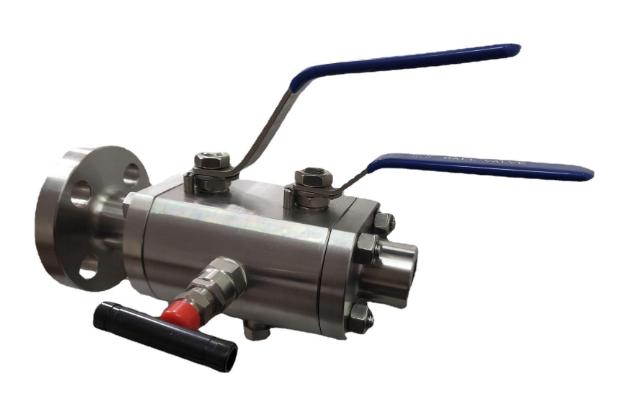
A forged integrated Double Block & Bleed (DBB) ball valve integrates an upstream shut-off ball valve, downstream shut-off ball valve and intermediate bleed needle valve within one single valve body. It realizes dual independent medium isolation and cavity pressure relief at one time, which fully replaces the traditional split layout of "2 ball valves + 1 drain valve" connected in series.
The valve body adopts three-piece integral forging construction with fewer external leakage points and compact layout. The displayed model is customized with flanged end + threaded end, matching mixed pipeline connection requirements for on-site installation.
2. Structure & Components Description
1.Forged Valve Body
Integral forging delivers high pressure resistance, strong vibration resistance and good tolerance to pipeline stress. End connections can be customized to flange, butt weld, compression fitting and other types to meet various piping standards.
2.Dual Independent Shut-off Ball Valves
Two separate extended operating levers are equipped for upstream and downstream valves, enabling independent on-off control to form double physical isolation. Anti-blowout stem design together with PTFE / flexible graphite packing effectively eliminates external leakage, and operation is smooth and effortless.
3.Integrated Bleed Needle Valve
A high-pressure bleed valve is mounted on the middle side of valve body. During maintenance, it empties trapped medium and residual pressure between two balls. External hose can be connected for medium recovery to avoid direct discharge risks and environmental contamination.
4.Sealing Structure
Independent ball and seat assemblies are available with PTFE soft seat, PEEK seat or Stellite metal hard seat, providing excellent bidirectional tight shut-off performance with zero bubble leakage.
3. Materials & Applicable Service Conditions
Standard valve body material: F304 / F316L stainless steel forging. For corrosive and sour medium, upgraded options include 2205 / 2507 duplex stainless steel, Hastelloy and other special alloys.Pressure class coverage: Class 150 ~ 2500LB for low to ultra-high pressure pipelines.Temperature range: -54℃ ~ 280℃. Soft seats suit normal-temperature clean medium, while metal hard seats support high-temperature and cryogenic LNG service.Applicable medium: natural gas, crude oil, refined oil, steam, acid & alkali chemical fluid, high-pressure hydrogen, instrument impulse line fluid, etc.
4. Design & Test Standards
All products comply with international industry specifications:API 6D for pipeline valves, ASME B16.34 for pressure-temperature rating, ASME B16.5 for flange dimensions, API 598 for seat leakage & hydrostatic test. API 607 fire safe certification can be supplied for oil & gas projects. Full inspection including body strength test and seat tightness test is implemented before delivery.
5. Key Product Advantages
1.Superior safety level: Dual independent sealing barriers with cavity bleed to verify isolation status, complying with safety codes for hot work maintenance in petrochemical and gas industries, greatly lowering leakage and misoperation risks.
2.Space-saving compact design: The integrated structure cuts overall length by 40% compared with split piping, ideal for metering skids and pressure regulating cabinets with limited space.
3.Easy installation & maintenance: Single-piece assembly for fast dismounting, fewer flanges and fittings to shorten on-site installation time. Centralized pressure relief operation without pipeline dismantling during overhaul.
4.Stable anti-vibration performance: Monoblock forged body avoids resonance of segmented pipes, suitable for vibrating lines connected to pumps and compressors with stable sealing performance over long service life.
5.Optimized total cost: Reduced investment on pipe fittings, supports, thermal insulation and NDT inspection, plus lower long-term cost for routine patrol and leakage repair.
6. Standard Operation Procedure for Maintenance Isolation
1.Fully close upstream and downstream ball valve levers sequentially;
2.Slowly open the middle bleed needle valve to drain trapped medium and residual cavity pressure. Start downstream maintenance only after zero pressure is confirmed;
3.After maintenance, fully close the bleed valve, slowly open the upstream valve for pressure pre-charging, then fully open the downstream valve to restore pipeline service.
7. Application Fields
Natural gas city gate station metering skids, oil & gas well gathering manifolds, inlet & outlet isolation for flowmeters in refineries, cryogenic LNG units, storage tank feed pipelines, reaction vessel isolation in fine chemical plants, high-pressure instrument piping in power stations, etc. It is a standard safety isolation valve for all skid-mounted equipment.
 How Does a Ball Type Check Valve Prevent Pipeline Medium Backflow?
  Selection and Precautions for Natural Gas Valves
  Athena Engineering S.R.L Wraps‑up OGA 2026 Kuala Lumpur
  What is a Gate Valve? What is Its Working Principle?
  T-Type / T-Pattern / Straight Pattern Globe Valve
  Knife Gate Valve vs Wedge Gate Valve: Which Is Better for Your Industrial Piping?
  Cryogenic Ball Valve Comprehensive Product Overview
  Causes and Treatments for Poor Valve Shut‑Off
  Athena Triple Offset Butterfly Valves
  What is the Difference Between Swing Check Valve and NRV? A Complete Explanation
  Common Connection Types of Valves
  5 Piping Design Mistakes That Are Killing Your Valves
  Float Valve: Structure, Principle and Application
  High Pressure Needle Valve High-Precision Fluid Control Valve
  What is a Piston Check Valve?
  Meet Us at OGA 2026 | Booth 6802, Hall 6
  What is a Level Gauge? Working Principles, Types and Industrial Applications
  Double Sealing Protection: A Complete Interpretation of Bellows Globe Valves
  End-Suction Pump vs Inline Pumps: Which One Is Right for You?
  Method of Selecting Valve Types Based on Throttling Degree