
Ultimate Guide to Pneumatic Butterfly Valves
2023-11-03
Pneumatic butterfly valves are essential components in various industries and applications, known for their versatility, reliability, and efficiency. In this comprehensive guide, we will delve deep into the world of pneumatic butterfly valves, providing you with a complete understanding of how they work, their diverse applications,and the advantages they offer.Whether you are a seasoned professional or a novice seeking valuable insights, this guide is your one-stop resource for all things pneumatic butterfly valves.
What Is a Pneumatic Butterfly Valve?
The pneumatic butterfly valve is a type of valve that controls the flow of fluids (liquids or gases) within a pipeline by adjusting the flow rate. The name of this valve is given by the way it operates, since it uses a disc or "butterfly" that rotates within the valve body to either allow fluid flow or restrict it.
Pneumatically actuated butterfly valves are common in many industries, including chemical, paper, coal, petroleum, medical treatment, etc. Pneumatic butterfly valves are primarily used in the chemical industry, paper industry, coal mining, petroleum, and medical treatment.
One of the most commonly used valves is the pneumatic control butterfly valve, which is mainly used in pneumatic pipelines. The larger the diameter, the more economical and economical the valve, and the more common it is on large and medium-diameter pipelines with low pressure.
A butterfly valve manufacturer can select different materials for sealing rings and parts in accordance with customer requirements, which will be suitable for a variety of media and working conditions, so that the pneumatic butterfly valve will be effective in many different situations.
Pneumatically actuated butterfly valves are common in many industries, including chemical, paper, coal, petroleum, medical treatment, etc. Pneumatic butterfly valves are primarily used in the chemical industry, paper industry, coal mining, petroleum, and medical treatment.
One of the most commonly used valves is the pneumatic control butterfly valve, which is mainly used in pneumatic pipelines. The larger the diameter, the more economical and economical the valve, and the more common it is on large and medium-diameter pipelines with low pressure.
A butterfly valve manufacturer can select different materials for sealing rings and parts in accordance with customer requirements, which will be suitable for a variety of media and working conditions, so that the pneumatic butterfly valve will be effective in many different situations.

Advantages of Pneumatic Butterfly Valves
- Compact and lightweight, facilitating effortless disassembly and maintenance. They can be installed in virtually any orientation.
- Sporting a straightforward and space-efficient design, these valves require minimal operating torque and swiftly open with a 90-degree rotation.
- Delivering a linear flow profile, these valves excel in regulating fluid flow.
- The butterfly plate's connection to the valve stem adopts a pinless design, eliminating potential internal leakage points.
- The exterior of the butterfly valve adopts a spherical shape, enhancing its sealing performance and extending the valve's operational lifespan. It maintains a leak-free seal even after enduring over 50,000 cycles of pressure-induced opening and closing.
- The sealing element is replaceable, providing an exceptionally dependable seal that accommodates bidirectional sealing.
- Upon request, butterfly plates can be coated with materials like nylon or PTFE for added protection.
- Pneumatic butterfly valves can be tailored with flange or clamp connections to suit specific needs.
- These valves offer flexibility in terms of their actuation method, with options including manual, electric, and pneumatic control, catering to user preferences.
Types of Pneumatic Butterfly Valves
In fact, there are several types of pneumatic butterfly valves, including pneumatic wafer butterfly valves, telescopic butterfly valves, ventilation butterfly valves and regulating butterfly valves. In the field of butterfly valves, the role of each butterfly valve varies depending on the application. As a result, when an enterprise purchases butterfly valves, it is imperative that they think about what type of butterfly valves are most suitable for their working environment when they make the purchase.
Butterfly Valve with Pneumatic Actuator Working Principle
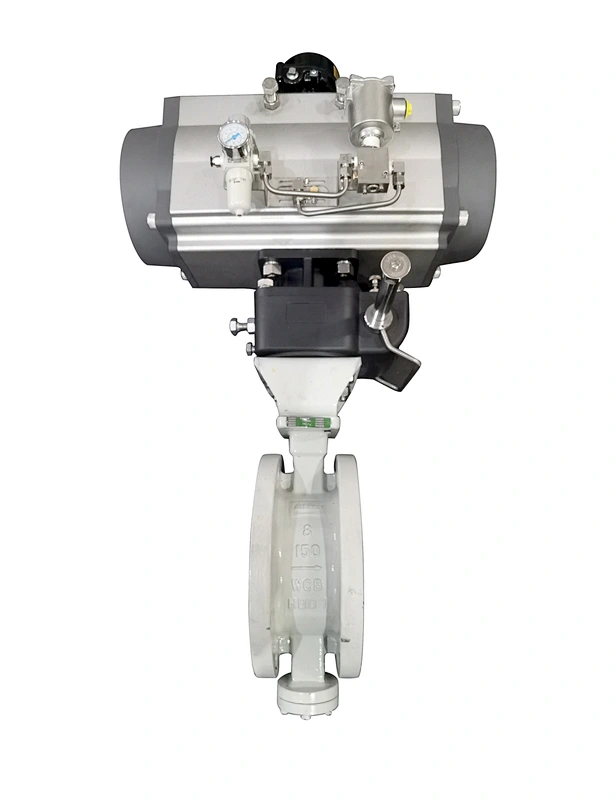
A pneumatic butterfly valve is powered by compressed air to control the rotation of a disc-shaped butterfly plate around an axis. The valve's starting position is set as needed. When the valve rotates 90 degrees from its initial position, one action is completed (either opening or closing the valve). The reverse holds true for the opposite action (from closed to open, or from open to closed).
Pneumatic butterfly valves operate swiftly, minimizing the risk of getting stuck or damaged during the process. Workers don't need to operate them manually. Pneumatic butterfly valve actuators come in two types: single-acting and double-acting. Double-acting means it uses air to open and air to close. Single-acting actuators also have a spring return function, automatically closing or opening the valve in case of air or power failure, making them highly safe.
Pneumatic butterfly valves operate swiftly, minimizing the risk of getting stuck or damaged during the process. Workers don't need to operate them manually. Pneumatic butterfly valve actuators come in two types: single-acting and double-acting. Double-acting means it uses air to open and air to close. Single-acting actuators also have a spring return function, automatically closing or opening the valve in case of air or power failure, making them highly safe.
Maintenance of Pneumatic Butterfly Valves
When maintaining pneumatic butterfly valves, pay attention to the following points:
- Ensure that the working conditions and environment meet the specified requirements. Take precautions to prevent the entry of impurities such as water and oil into the actuator or valve, as they can reduce the valve's lifespan. Regular maintenance is essential, including the addition of lubricating oil and the removal of surface dirt and dust.
- During installation, follow the appropriate connection method to attach the valve directly to the pipeline. In most cases, it can be placed at any position within the pipeline but should be easily accessible for maintenance. Note that when using a shut-off valve, the medium flow should be directed upwards from the vertical valve disc.
- When utilizing a pneumatic butterfly valve, be aware that it should only be fully opened or fully closed. Attempting to use it for flow rate adjustments can lead to erosion and increased wear of the sealing surface.
- In case of disassembly, take care to protect the valve body's sealing surface from damage caused by collisions or scratches. If any abnormal issues arise, preventing normal operation, shut off the air supply and the medium to identify the cause. The valve can be used again after successful testing.
- When opening and closing the pneumatic butterfly valve, use the handwheel. Avoid using levers or other tools to prevent valve damage. Turn the handwheel clockwise to close the valve and counterclockwise to open it.
- For long-term storage, ensure the valve is stored in a well-ventilated and dry location. When storing the pneumatic butterfly valve, close and block both ends of the passage to prevent damage caused by moisture or extended exposure to the elements.
Where to Purchase Pneumatic Butterfly Valves?
If you're seeking reliable sources for purchasing pneumatic butterfly valves, Athena Engineering S.R.L stands out as a prominent manufacturer of both pneumatic and electric butterfly valves. Their product line boasts butterfly valves featuring top-tier corrosion-resistant discs and stems, making them well-suited for applications in chemical and food processing industries. Additionally, their innovative encapsulated design ensures that contaminants do not compromise the valve's performance.
Athena Engineering S.R.L takes their commitment to product quality seriously, having established a dedicated research and development team that focuses on designing and developing butterfly valves. This commitment ensures the high quality of their valves while maintaining competitive pricing.
When in the market for pneumatic butterfly valves, it is advisable for buyers to conduct a thorough evaluation and analysis of products from various manufacturers. Prioritizing manufacturers with a strong reputation, such as Athena Engineering S.R.L, can help ensure the acquisition of satisfactory products.
Athena Engineering S.R.L takes their commitment to product quality seriously, having established a dedicated research and development team that focuses on designing and developing butterfly valves. This commitment ensures the high quality of their valves while maintaining competitive pricing.
When in the market for pneumatic butterfly valves, it is advisable for buyers to conduct a thorough evaluation and analysis of products from various manufacturers. Prioritizing manufacturers with a strong reputation, such as Athena Engineering S.R.L, can help ensure the acquisition of satisfactory products.
 How Does a Ball Type Check Valve Prevent Pipeline Medium Backflow?
  Selection and Precautions for Natural Gas Valves
  Athena Engineering S.R.L Wraps‑up OGA 2026 Kuala Lumpur
  What is a Gate Valve? What is Its Working Principle?
  T-Type / T-Pattern / Straight Pattern Globe Valve
  Knife Gate Valve vs Wedge Gate Valve: Which Is Better for Your Industrial Piping?
  Cryogenic Ball Valve Comprehensive Product Overview
  Causes and Treatments for Poor Valve Shut‑Off
  Athena Triple Offset Butterfly Valves
  What is the Difference Between Swing Check Valve and NRV? A Complete Explanation
  Common Connection Types of Valves
  5 Piping Design Mistakes That Are Killing Your Valves
  Float Valve: Structure, Principle and Application
  High Pressure Needle Valve High-Precision Fluid Control Valve
  What is a Piston Check Valve?
  Meet Us at OGA 2026 | Booth 6802, Hall 6
  What is a Level Gauge? Working Principles, Types and Industrial Applications
  Double Sealing Protection: A Complete Interpretation of Bellows Globe Valves
  End-Suction Pump vs Inline Pumps: Which One Is Right for You?
  Method of Selecting Valve Types Based on Throttling Degree