
High Pressure Needle Valve High-Precision Fluid Control Valve
author: ATHENA GROUP
2026-08-07
1. Product Overview
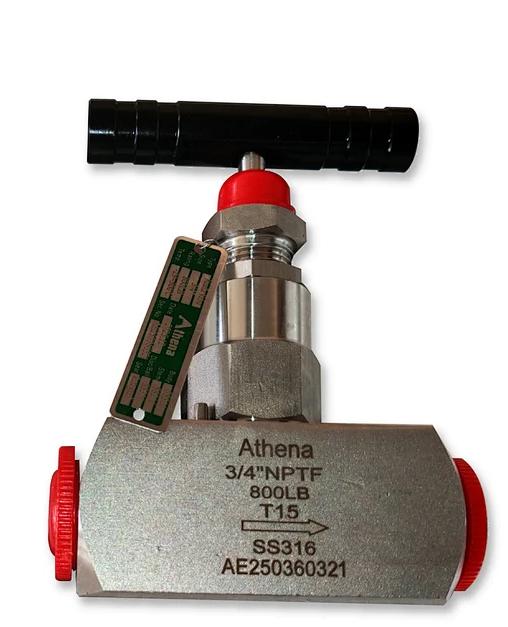
Needle valve is a sophisticated miniature shut-off and throttling valve, characterized by its elongated tapered needle-pointed core. It serves as a vital precision fitting in industrial automated monitoring and fluid piping systems. Engineered for delicate micro-flow modulation and rapid medium isolation in high-pressure pipe networks, the component boasts agile actuation, superior regulating precision, reliable tightness and exceptional pressure endurance. In contrast to generic valves including ball valves and gate valves, the needle valve integrates a short-travel spindle and fine-pitch thread drive mechanism, enabling seamless stepless micro-flow adjustment without abrupt hydraulic fluctuation. Optimized for high-pressure and low-flow precision operating conditions, it is extensively deployed in fine chemical, power generation, electro-pneumatic and instrument piping sectors, functioning as a specialized core component for high-accuracy fluid management applications.

2. Structure and Working Principle
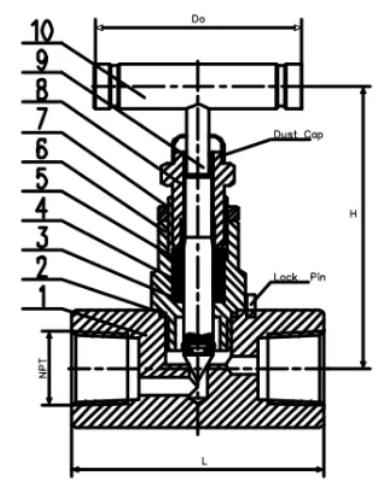
The needle valve adopts a streamlined and compact configuration, facilitating effortless assembly and routine upkeep. Its primary assemblies consist of a valve body, tapered needle core, valve spindle, compression packing and manual handwheel. As the prime pressure-bearing enclosure, the valve body is equipped with finely machined internal passages and a high-precision tapered seat, which forms a flawless sealing interface with the needle core for leak-tight performance. Its operational mechanism is stable and intuitive. Rotation of the handwheel converts into vertical linear movement of the spindle, modulating the aperture gap between the core and seat. Clockwise rotation forces the core to tightly compress against the seat, fully blocking the flow passage and terminating medium delivery. Counterclockwise rotation elevates the core incrementally, allowing precise modulation of fluid velocity and volumetric flow by altering the passage clearance, which perfectly accommodates the meticulous fluid control demands of diverse industrial equipment.
3. Main Classification
In accordance with internal passage layout, needle valves are categorized into straight-type and angle-type variants. Straight-type models suit standard linear piping arrangements, while angle-type versions are tailored for constrained installation spaces such as pipeline turning points and pressure gauge terminal connections. In terms of connection configurations, the product covers threaded, ferrule compression, welded and flange connections. Threaded and ferrule-type valves feature hassle-free installation and disassembly, predominantly utilized for instrument sampling pipelines; welded and flange-type units deliver enhanced sealing robustness, ideal for high-temperature and high-pressure industrial piping systems. Based on manufacturing materials, they are available in stainless steel, carbon steel and special alloy grades, adapting to ambient temperature, high-temperature and corrosive service environments correspondingly.
4. Product Advantages and Application Scenarios
Needle valves possess remarkable comprehensive operational merits. Their ultra-compact and lightweight structure allows flexible deployment in confined spaces such as control cabinets and narrow pipeline layouts. Equipped with a tapered hard-sealing configuration, the valves maintain near-zero leakage under extreme pressure, exhibiting far more dependable tightness than conventional regulating valves. The precision thread drive system substantially elevates flow control accuracy for ultra-fine micro-flow management.
Furthermore, mainstream stainless steel and carbon steel casings deliver outstanding thermal stability, pressure resistance and anti-corrosion capability, guaranteeing structural robustness and prolonged service lifespan. Widely implemented in power plant steam sampling, petrochemical fluid transportation, instrument pressure signal acquisition, electro-pneumatic control systems and new energy laboratory fluid proportioning, the valve is capable of isolating and fine-tuning multiple mediums including water, steam, petroleum products, gas and mild acid-base solutions, establishing itself as an essential foundational component in modern high-precision industrial monitoring and control systems.
 How Does a Ball Type Check Valve Prevent Pipeline Medium Backflow?
  Selection and Precautions for Natural Gas Valves
  Athena Engineering S.R.L Wraps‑up OGA 2026 Kuala Lumpur
  What is a Gate Valve? What is Its Working Principle?
  T-Type / T-Pattern / Straight Pattern Globe Valve
  Knife Gate Valve vs Wedge Gate Valve: Which Is Better for Your Industrial Piping?
  Cryogenic Ball Valve Comprehensive Product Overview
  Causes and Treatments for Poor Valve Shut‑Off
  Athena Triple Offset Butterfly Valves
  What is the Difference Between Swing Check Valve and NRV? A Complete Explanation
  Common Connection Types of Valves
  5 Piping Design Mistakes That Are Killing Your Valves
  Float Valve: Structure, Principle and Application
  What is a Piston Check Valve?
  Meet Us at OGA 2026 | Booth 6802, Hall 6
  What is a Level Gauge? Working Principles, Types and Industrial Applications
  Double Sealing Protection: A Complete Interpretation of Bellows Globe Valves
  End-Suction Pump vs Inline Pumps: Which One Is Right for You?
  Method of Selecting Valve Types Based on Throttling Degree
  Safety Valves–Core Protection for Pressure Equipment