
What is a Diaphragm Valve
author: ATHENA GROUP
2026-06-08

A diaphragm valve is a type of stop valve that uses a diaphragm as the closing member to seal the flow path, shut off fluid, and separate the valve body cavity from the bonnet cavity. Diaphragms are typically made of elastic, corrosion-resistant, and non-permeable materials such as rubber and plastic. It features a simple structure, good sealing and anti-corrosion performance, and low flow resistance. It is used for low-pressure, low-temperature, highly corrosive media, and media containing suspended solids.

1. Working Principle and Components
Diaphragm valves use a corrosion-resistant lined valve body and a corrosion-resistant diaphragm instead of a valve core assembly, and regulate flow through the movement of the diaphragm. The valve body is made of cast iron, cast steel, or cast stainless steel, lined with various corrosion-resistant or wear-resistant materials; diaphragms are made of rubber and polytetrafluoroethylene (PTFE). The lined diaphragm has strong corrosion resistance, suitable for regulating highly corrosive media such as strong acids and alkalis.
Diaphragm valves have a simple structure and low flow resistance, with a larger flow capacity than other types of valves of the same specification. They are leak-free and can regulate high-viscosity media and media with suspended particles. The diaphragm isolates the medium from the upper chamber of the valve stem, so no external leakage occurs even without packing. However, limited by diaphragm and lining materials, they have poor pressure and temperature resistance, generally applicable to nominal pressure up to 1.6 MPa and temperatures below 150 °C.
2. Sealing Principle
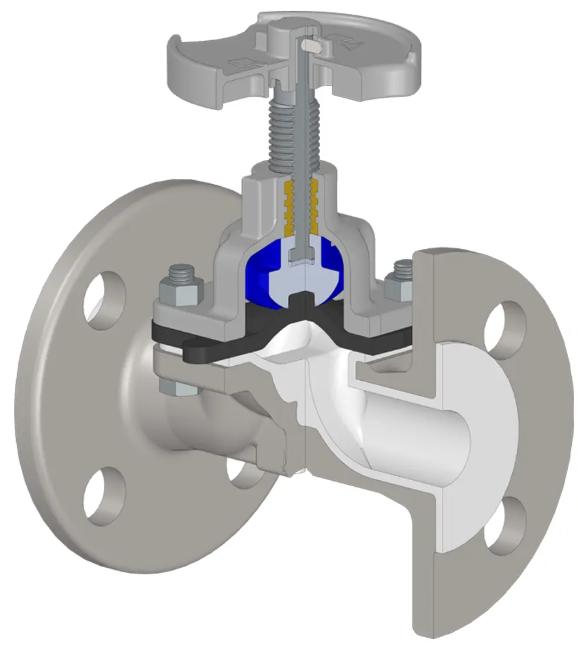
The sealing principle of a diaphragm valve is that the downward movement of the operating mechanism presses the diaphragm or diaphragm assembly against the passage of the weir-type lined valve body or straight-through lined valve body to achieve sealing. The sealing specific pressure is determined by the downward pressure of the closing member. Since the valve body can be lined with various soft materials (e.g., rubber or PTFE) and the diaphragm is also made of soft materials (e.g., rubber or PTFE lined with synthetic rubber), complete sealing can be achieved with a small sealing force.
A diaphragm valve consists of only three main components: the valve body, the diaphragm, and the bonnet assembly. The diaphragm separates the lower valve body cavity from the upper bonnet cavity, so components above the diaphragm (such as the valve stem, stem nut, disc, pneumatic actuator, and electric actuator) do not contact the medium, and no external leakage occurs, eliminating the need for a packing seal structure.
3. Features
1) Low flow resistance.
2) Suitable for media containing hard suspended solids; since the medium only contacts the valve body and diaphragm, no packing box is needed, eliminating packing leakage and avoiding corrosion of the valve stem.
3) Applicable to corrosive, viscous, and slurry media.
4) Not suitable for high-pressure applications.

As a special type of stop valve, diaphragm valves are limited by valve body lining and diaphragm manufacturing processes, making large-size body lining and large diaphragms difficult to produce. Therefore, they are not suitable for large pipe diameters and are generally used on pipelines ≤ DN200. Diaphragm valves are suitable for low-pressure and low-temperature applications, generally not exceeding 180 °C. With excellent anti-corrosion performance, they are mostly used in plants and pipelines for corrosive media.
 How Does a Ball Type Check Valve Prevent Pipeline Medium Backflow?
  Selection and Precautions for Natural Gas Valves
  Athena Engineering S.R.L Wraps‑up OGA 2026 Kuala Lumpur
  What is a Gate Valve? What is Its Working Principle?
  T-Type / T-Pattern / Straight Pattern Globe Valve
  Knife Gate Valve vs Wedge Gate Valve: Which Is Better for Your Industrial Piping?
  Cryogenic Ball Valve Comprehensive Product Overview
  Causes and Treatments for Poor Valve Shut‑Off
  Athena Triple Offset Butterfly Valves
  What is the Difference Between Swing Check Valve and NRV? A Complete Explanation
  Common Connection Types of Valves
  5 Piping Design Mistakes That Are Killing Your Valves
  Float Valve: Structure, Principle and Application
  High Pressure Needle Valve High-Precision Fluid Control Valve
  What is a Piston Check Valve?
  Meet Us at OGA 2026 | Booth 6802, Hall 6
  What is a Level Gauge? Working Principles, Types and Industrial Applications
  Double Sealing Protection: A Complete Interpretation of Bellows Globe Valves
  End-Suction Pump vs Inline Pumps: Which One Is Right for You?
  Method of Selecting Valve Types Based on Throttling Degree