
What is a Basket Type Strainer
author: ATHENA GROUP
2026-06-15
A basket type strainer is a commonly used coarse filtration equipment in pipeline systems. It is applied to oil and other liquid pipelines to filter impurities inside the pipelines. Its filtering hole area is 2 to 3 times larger than the cross-sectional area of the nominal diameter pipeline, far exceeding the filtering area of Y-type and T-type strainers. It features excellent filtration accuracy among various strainers. Its filter screen structure is different from other filter screens, and it is named the basket type strainer due to its basket-like shape.
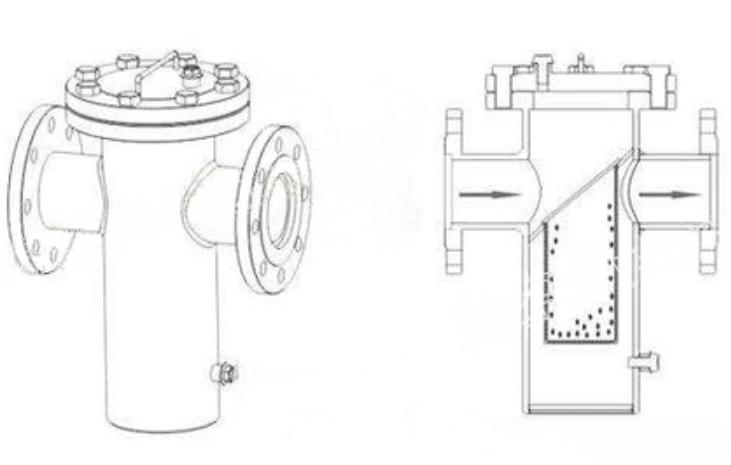
The basket type strainer is mainly composed of connecting pipe, cylinder body, filter basket, flange, flange cover and fasteners. Installed on pipelines, it can remove large solid impurities from fluid, ensure the normal operation of mechanical equipment (including compressors, pumps, etc.) and instruments, stabilize the technological process and guarantee safe production.
The basket type strainer is mainly composed of connecting pipe, cylinder body, filter basket, flange, flange cover and fasteners. Installed on pipelines, it can remove large solid impurities from fluid, ensure the normal operation of mechanical equipment (including compressors, pumps, etc.) and instruments, stabilize the technological process and guarantee safe production.

1. Structural Composition
- Body: Made of carbon steel / stainless steel (304/316L), with flange connection at both ends; a quick-opening flange cover is arranged at the top / side, and a sewage outlet is optional at the bottom.
- Filter Basket: The core component, made of stainless steel wire mesh / perforated plate in basket shape, equipped with a handle for easy taking out; the mesh size ranges from 10 to 300 meshes, and the filtration accuracy can be customized.
- Sealing and Fastening Parts: Flanges, gaskets and bolts. The quick-opening structure can be equipped with buckles for fast cover opening without tools.
2. Working Principle
a.Fluid enters the shell from the inlet and flows to the outer side of the filter basket.
b.Solid impurities (sediment, rust, welding slag) are intercepted inside or outside the filter basket, and the clean fluid flows out from the outlet through the filter screen.
c.When the pressure difference rises due to impurity accumulation (usually ≥0.05MPa), shut down the equipment, open the cover, take out the filter basket, clean it and install it back. The bottom blowdown valve can regularly discharge sediment to reduce cleaning frequency.
3. Core Features
- Large filtration area: The area of the filter basket is 2 to 5 times the cross-sectional area of the pipeline, much larger than that of Y-type / T-type strainers, with strong dirt holding capacity and long cleaning cycle.
- Low pressure loss: The flow channel is gentle with pressure loss ≤0.05MPa, having little impact on system flow.
- Convenient maintenance: Adopting quick-opening design, the filter basket can be taken out and cleaned in a few minutes without dismantling the pipeline.
- Wide working condition adaptability: Applicable pressure ranges from 0.6–6.4MPa (up to 16MPa for high pressure type), working temperature ≤400℃. It is suitable for water, oil, gas and corrosive media.

4. Application Scenarios
- Water Treatment: Industrial circulating water, sewage pretreatment and raw tap water filtration, protecting membrane modules and heat exchangers.
- Petrochemical Industry: Filtration of crude oil, refined oil and lubricating oil to intercept mechanical impurities and protect pumps and compressors.
- Food and Pharmaceutical Industry: Filtration of fruit juice, beer and liquid medicine to remove residues and ensure hygiene and purity.
- Others: Filtration of compressed air and gas; impurity removal for coatings, inks and chemical solvents.
With extremely convenient use and maintenance, basket type strainers are widely used in petroleum, chemical, pharmaceutical, food, environmental protection and other industries. Installed in series at the inlet of pumps or other parts of system pipelines, they can not only extend the service life of pumps and other equipment, but also ensure the safety of the entire system.
 How Does a Ball Type Check Valve Prevent Pipeline Medium Backflow?
  Selection and Precautions for Natural Gas Valves
  Athena Engineering S.R.L Wraps‑up OGA 2026 Kuala Lumpur
  What is a Gate Valve? What is Its Working Principle?
  T-Type / T-Pattern / Straight Pattern Globe Valve
  Knife Gate Valve vs Wedge Gate Valve: Which Is Better for Your Industrial Piping?
  Cryogenic Ball Valve Comprehensive Product Overview
  Causes and Treatments for Poor Valve Shut‑Off
  Athena Triple Offset Butterfly Valves
  What is the Difference Between Swing Check Valve and NRV? A Complete Explanation
  Common Connection Types of Valves
  5 Piping Design Mistakes That Are Killing Your Valves
  Float Valve: Structure, Principle and Application
  High Pressure Needle Valve High-Precision Fluid Control Valve
  What is a Piston Check Valve?
  Meet Us at OGA 2026 | Booth 6802, Hall 6
  What is a Level Gauge? Working Principles, Types and Industrial Applications
  Double Sealing Protection: A Complete Interpretation of Bellows Globe Valves
  End-Suction Pump vs Inline Pumps: Which One Is Right for You?
  Method of Selecting Valve Types Based on Throttling Degree