
Safety Valves–Core Protection for Pressure Equipment
author: ATHENA GROUP
2026-07-14
1. Definition and Function
A safety valve is an automatic pressure relief protection valve actuated by the pressure of the process medium itself.
- Working logic: Auto opens to discharge medium when system pressure exceeds preset value; auto closes when pressure returns to safe range.
- Core function: Limit system pressure within allowable range, prevent explosion of pressure vessels and pipelines, the key safety fitting for pressure-bearing equipment.
- Usage restriction: Only for overpressure protection, normally closed; cannot be used as conventional isolation valves.
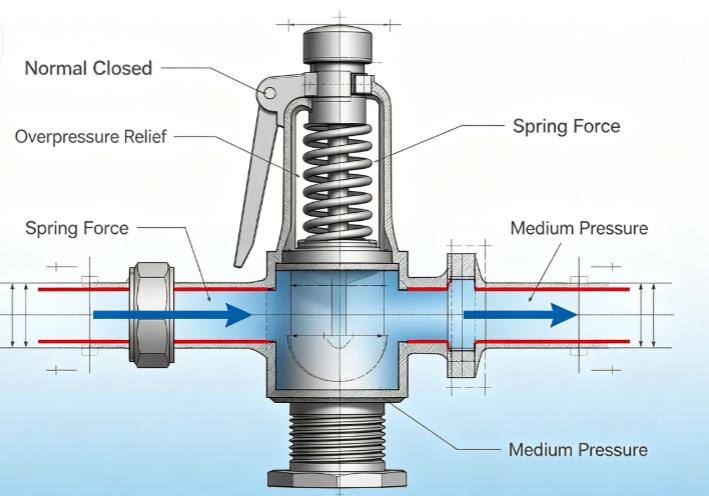
2. Basic Working Principle
- System medium pressure generates upward thrust on valve disc; spring/weight supplies downward preload to seal the disc tightly.
- Normal condition: Medium thrust < spring force → valve stays sealed.
- Overpressure state: Medium thrust exceeds spring load → disc lifts for medium discharge.
- Pressure drops to re-seating pressure → spring pushes disc back to closed position.
3. Main Components
- Seat: Fixed sealing base & medium flow channel
- Disc: Opening/closing sealing part, forms sealing pair with seat
- Spring: Provides sealing preload, core part of spring-type safety valves
- Stem: Transmits spring load
- Adjusting screw: Calibrates set pressure
- Body & bonnet: Pressure-bearing shell
- Lifting lever: For on-site manual opening test
- Guide sleeve: Keeps disc moving vertically to avoid jamming

4. Main Classification
1.Spring-loaded safety valve
Sealed by spring force; compact, flexible installation orientation, widely applied in all industries.

2.Weight-lever safety valve
Loaded by weights and levers; stable pressure performance, fit for high-temperature boilers; large size, must be vertically mounted.

3.Pilot-operated safety valve
Consists of main valve and pilot valve; small blowdown, good tightness, suitable for high-pressure & large-flow working conditions.

5. Key Performance Terminology
- Set Pressure: Calibrated pressure when the valve starts to open
- Relieving Pressure: Inlet pressure at rated discharge capacity
- Re-seating Pressure: Pressure when the valve fully closes after pressure relief
- Blowdown: Pressure difference between set pressure and re-seating pressure
- Rated Discharge Capacity: Stable medium flow rate under standard working conditions
- Seat Tightness Test Pressure: Pressure lower than set pressure for leakage inspection
6. Basic Selection Guidelines
- Medium type: Low-lift for liquid; full-lift for steam & gas
- Medium hazard: Closed structure for toxic, flammable media
- Materials: Match valve body & sealing material with temperature and design pressure
- Specification: Calculate required relief capacity to confirm valve size
- Installation: Check space and connection standards (RF flange, NPT thread, etc.)
- Special measures: Insulate springs from high heat; protect sealing surfaces for particle-containing medium
7. General Installation Requirements
- Mount vertically upward as standard.
- Shorten inlet pipelines; no isolation valves on inlet. If bypass valve exists, lock it open with lead seal.
- Support discharge pipelines independently to avoid pipeline load on valve body.
- Set drain pockets at discharge pipe low points to eliminate condensate backpressure.
 How Does a Ball Type Check Valve Prevent Pipeline Medium Backflow?
  Selection and Precautions for Natural Gas Valves
  Athena Engineering S.R.L Wraps‑up OGA 2026 Kuala Lumpur
  What is a Gate Valve? What is Its Working Principle?
  T-Type / T-Pattern / Straight Pattern Globe Valve
  Knife Gate Valve vs Wedge Gate Valve: Which Is Better for Your Industrial Piping?
  Cryogenic Ball Valve Comprehensive Product Overview
  Causes and Treatments for Poor Valve Shut‑Off
  Athena Triple Offset Butterfly Valves
  What is the Difference Between Swing Check Valve and NRV? A Complete Explanation
  Common Connection Types of Valves
  5 Piping Design Mistakes That Are Killing Your Valves
  Float Valve: Structure, Principle and Application
  High Pressure Needle Valve High-Precision Fluid Control Valve
  What is a Piston Check Valve?
  Meet Us at OGA 2026 | Booth 6802, Hall 6
  What is a Level Gauge? Working Principles, Types and Industrial Applications
  Double Sealing Protection: A Complete Interpretation of Bellows Globe Valves
  End-Suction Pump vs Inline Pumps: Which One Is Right for You?
  Method of Selecting Valve Types Based on Throttling Degree