
How does a swing check valve work?
author: ATHENA GROUP
2026-04-10
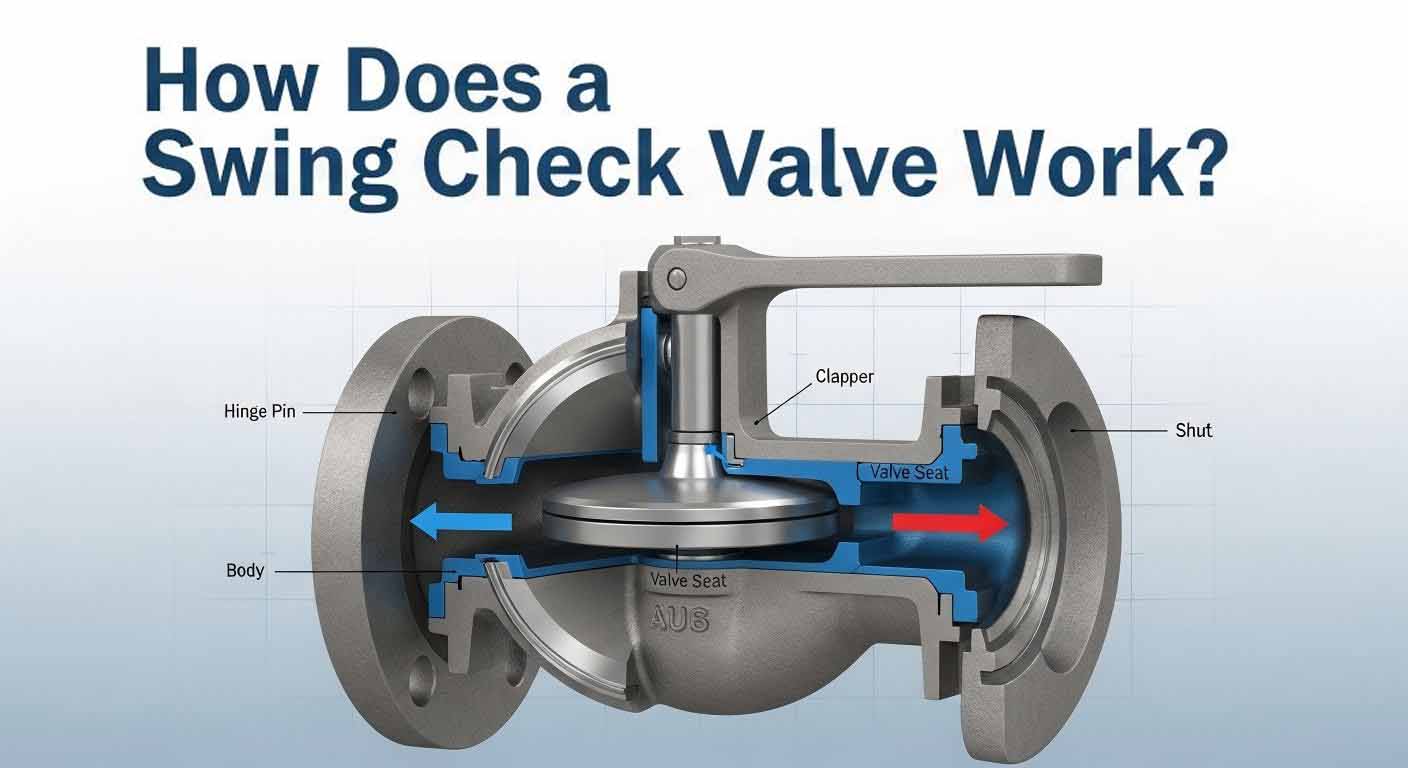
Detailed Explanation of Swing Check Valve
A check valve is a basic valve in industrial pipeline systems. Its core function is to restrict fluid flow to only one direction and prevent backflow from damaging equipment. It is also know as a card valve, non-return valve, one-way valve, etc. According to its structure, it can be divided into swing type, tilting disc type, piston type, butterfly type and stop-check valve. This session will focus on the swing check valve, which is the most widely used and simplest in structure.
Structure of Swing Check Valve

The swing check valve has a simple structure, convenient assembly and clear division of labor among components. Its top is a bonnet, which not only seals and protects internal components but also facilitates maintenance.
It is fixed on the valve body by bolts around the edge, and the connection is sealed with a gasket. The material of the gasket is selected according to the fluid properties, temperature and pressure. A bolt interface is reserved in the center of the bonnet for installing a pressure gauge or a vent valve, which is convenient for pressure monitoring and venting during maintenance.
The gasket is a key sealing component, used to seal the gap between the valve body and the bonnet to avoid fluid leakage. It is made of soft materials with good sealing performance, such as rubber and PTFE, which can adapt to different working environments and ensure the long-term sealing reliability of the valve, reducing potential safety hazards and resource waste.
The valve seat is a core component for achieving one-way sealing. It is the contact part between the valve body and the valve disc. After precision processing, it can closely fit with the valve disc, separate the inlet and outlet of the valve, and prevent fluid backflow. Its material is usually the same as that of the valve body, mostly corrosion-resistant and wear-resistant materials such as cast iron, cast steel and stainless steel. In special scenarios, wear-resistant alloys can be used to extend the service life.
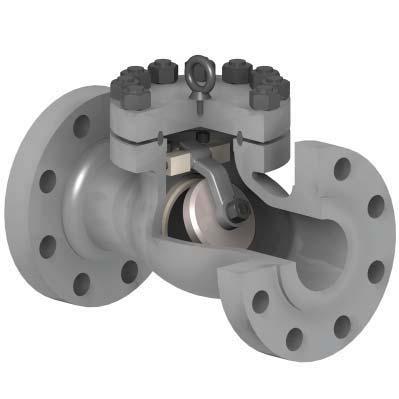
The valve disc is the core component for controlling one-way fluid flow. Its main body is a precision-machined circular metal plate, whose size and thickness are designed according to the valve specification, pressure and flow rate. It is connected to the valve body through a hinge mechanism. When the fluid flows forward, the valve disc opens; when the fluid flows backward, it closes quickly and fits the valve seat to block backflow.
There are two symmetrical flanges at the end of the valve, whose specification must match the pipeline to ensure stable connection and sealing. The flange can be connected to the pipeline by bolts (convenient for maintenance) or welding (firm connection and good sealing, suitable for high-pressure and high-flow scenarios). Both ends of the flange also need to be sealed with gaskets to prevent fluid leakage.
Working Principle of Swing Check Valve
The swing check valve opens and closes automatically relying on the fluid pressure difference and the weight of the valve disc, without manual or electric control. At rest, the valve disc is pressed tightly against the valve seat under the action of its own weight and the fluid pressure at the outlet, and the valve is closed to prevent fluid backflow and protect the downstream equipment and pipeline safety.
When the pipeline is in operation, the fluid pressure at the inlet increases. When it overcomes the sum of the weight of the valve disc and the outlet pressure, the valve disc rotates around the hinge to leave the valve seat, and the valve opens, allowing the fluid to flow forward. The pressure at which the fluid starts to flow is called the cracking pressure, which can be adjusted according to the valve specification and fluid properties. As the pressure continues to increase, the valve disc is fully opened, and at this time, the fluid resistance is the smallest and the flow rate is the largest.
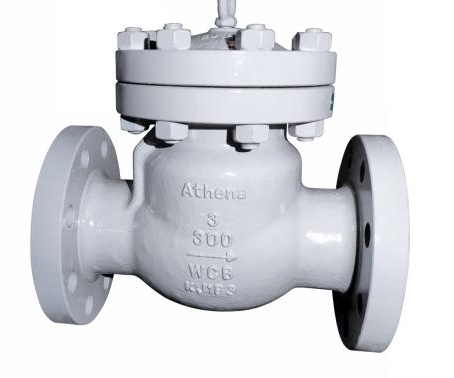
When the pipeline stops operating or backflow occurs, the fluid pressure at the outlet is greater than that at the inlet. Under the action of the reverse pressure, the valve disc is pressed back to the valve seat quickly, and the valve closes to block fluid backflow, avoiding impact damage to the equipment.
Advantages and Disadvantages of Swing Check Valve
The swing check valve is widely used but also has limitations. Its advantages and disadvantages are detailed below to facilitate selection according to actual scenarios.
Its most prominent advantage is the low pressure drop between the inlet and outlet and small fluid resistance, which is suitable for high-flow and low-velocity scenarios, reducing energy loss and operating costs. At the same time, the fluid generates little turbulence when passing through, which can reduce the scouring and wear of components, extend the valve service life, and reduce noise and vibration.

In addition, it is convenient to maintain. When the valve leaks, there is no need to disassemble the entire valve from the pipeline. You only need to open the bonnet and replace vulnerable components such as the valve seat ring and valve disc, which saves maintenance time and costs and reduces the downtime of the pipeline system. Its components have a simple structure and strong versatility, making it convenient to purchase and replace vulnerable components.
Its main disadvantage is that it is not suitable for systems with large pressure fluctuations. Frequent pressure fluctuations will cause the valve disc to open and close repeatedly, wear the valve disc and valve seat, and lead to internal leakage. In addition, a slight water hammer will occur when the valve closes, so it should be used with caution in pipeline systems sensitive to water hammer.
 How Does a Ball Type Check Valve Prevent Pipeline Medium Backflow?
  Selection and Precautions for Natural Gas Valves
  Athena Engineering S.R.L Wraps‑up OGA 2026 Kuala Lumpur
  What is a Gate Valve? What is Its Working Principle?
  T-Type / T-Pattern / Straight Pattern Globe Valve
  Knife Gate Valve vs Wedge Gate Valve: Which Is Better for Your Industrial Piping?
  Cryogenic Ball Valve Comprehensive Product Overview
  Causes and Treatments for Poor Valve Shut‑Off
  Athena Triple Offset Butterfly Valves
  What is the Difference Between Swing Check Valve and NRV? A Complete Explanation
  Common Connection Types of Valves
  5 Piping Design Mistakes That Are Killing Your Valves
  Float Valve: Structure, Principle and Application
  High Pressure Needle Valve High-Precision Fluid Control Valve
  What is a Piston Check Valve?
  Meet Us at OGA 2026 | Booth 6802, Hall 6
  What is a Level Gauge? Working Principles, Types and Industrial Applications
  Double Sealing Protection: A Complete Interpretation of Bellows Globe Valves
  End-Suction Pump vs Inline Pumps: Which One Is Right for You?
  Method of Selecting Valve Types Based on Throttling Degree