
Ball Valve is better than Check Valve?
author: ATHENA GROUP
2026-02-07
Valves are critical components in fluid handling systems, regulating flow, pressure, and direction to ensure operational efficiency and safety. Among the most widely used valve types are check valves and ball valves—each designed with distinct mechanisms, purposes, and performance characteristics. While both serve essential roles in industries ranging from oil and gas to water treatment, understanding their differences is vital for selecting the right valve for specific applications. This article explores the core distinctions between check valves and ball valves, including design, functionality, applications, and key performance factors.
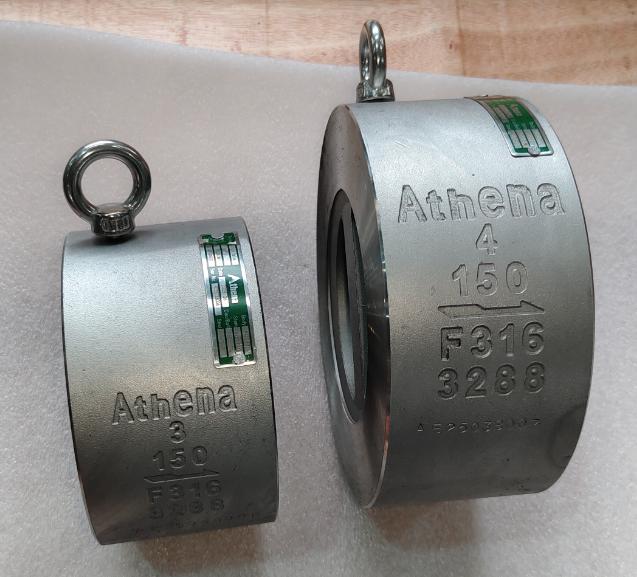
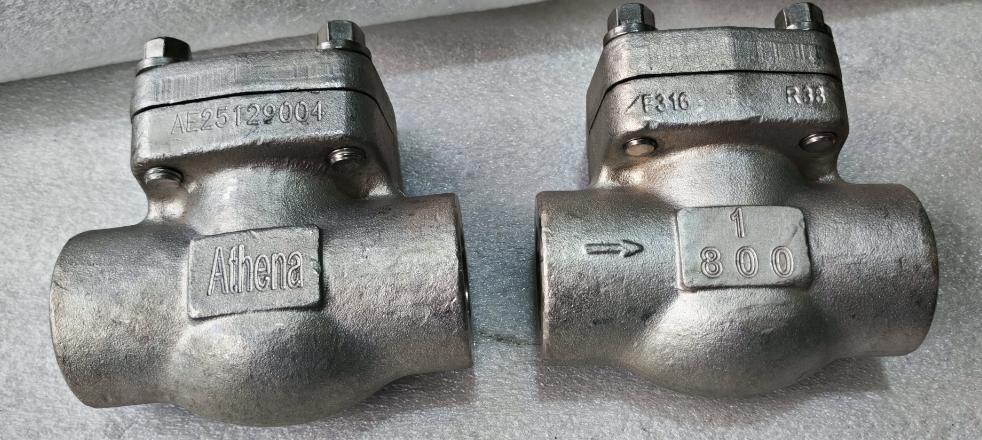
1. Core Function and Operating Principle
Check Valves: One-Way Flow Control
A check valve (also known as a non-return valve) is a passive flow control device designed to allow fluid to flow in only one direction, preventing back flow. Its operation relies entirely on the pressure differential of the fluid itself—no external actuation (e.g., handles, motors) is required. When forward flow pressure exceeds the opposing pressure (e.g., back pressure or spring force), the valve’s internal mechanism (e.g., a disc, ball, or swing gate) opens to permit flow. When flow reverses or stops, the mechanism closes automatically, sealing the pipeline to prevent back flow that could damage equipment, contaminate fluids, or disrupt system operations.
Common check valve designs include:
•Swing check valves: Utilize a hinged disc that swings open with forward flow and closes via gravity or back pressure.
•Single Plate Check Valve:A swing check valve with a single integral disc hinged to the valve body, sealed by disc gravity and back pressure, optional with weight/spring for quick closing.
•Dual Plate Check Valve:A compact wafer-type swing check valve with two split discs hinged to a central shaft, equipped with a spring for fast closing, sealed by spring force and back pressure, no external weight.
•Ball check valves: Feature a spherical ball that seats against an orifice to block reverse flow.
•Spring-loaded check valves: Incorporate a spring to assist in closing, ensuring rapid sealing even at low pressures.
Ball Valves: On-Off and Throttling Control
A ball valve is an active flow control device that uses a hollow, perforated ball (the “ball”) to regulate flow. The ball is connected to a stem, which is actuated manually (via a handle), pneumatically, hydraulically, or electrically. When the stem is turned, the ball rotates: aligning the ball’s hole with the pipeline allows full flow, while rotating the ball 90 degrees blocks flow entirely. Some ball valve designs (e.g., V-port balls) can also be used for throttling—controlling flow rate by partially opening the valve.
Key ball valve variations include:
•Full-port ball valves: The ball’s hole matches the pipeline diameter, minimizing flow restriction.
•Reduced-port ball valves: The ball’s hole is smaller than the pipeline diameter, offering cost savings but higher pressure drop.
•Trunnion-mounted ball valves: Used for high-pressure, large-diameter applications, with the ball supported by trunnions to reduce friction.
2. Key Design and Performance Differences
| Parameter | Check Valve | Ball Valve |
| Actuation | Passive (pressure-driven, no external control) | Active (manual, pneumatic, hydraulic, electric) |
| Flow Direction | Unidirectional (prevents backflow) | Bidirectional (flows in either direction) |
| Flow Control | Only on/off (no throttling capability) | On/off (primary) + throttling (some designs) |
| Pressure Drop | Moderate to high (depends on valve type) | Low (full-port) to moderate (reduced-port) |
| Sealing | Relies on pressure differential or spring force | Tight sealing via ball-to-seat contact (often metal or soft seats) |
| Response Time | Instant (closes immediately on backflow) | Fast (90-degree rotation for on/off) |
| Maintenance | Low (few moving parts; minimal wear) | Moderate (stem seals may require replacement; ball/seat wear in throttling apps) |
| Size Range | Small to large (1/8” to 48”+ pipeline diameter) | Small to very large (1/4” to 60”+ pipeline diameter) |
3. Applications: When to Use Each Valve
Check Valve Applications
Check valves are indispensable in systems where backflow could cause damage, contamination, or inefficiency. Common uses include:
•Plumbing and water systems: Preventing water from reversing in pipes (e.g., in hot water heaters, sump pumps, or irrigation systems).
•HVAC systems: Stopping refrigerant backflow in air conditioners and heat pumps.
•Oil and gas pipelines: Preventing hydrocarbon backflow in wellheads, pipelines, and processing plants.
•Chemical processing: Protecting pumps, reactors, and storage tanks from corrosive fluid backflow.
•Steam systems: Avoiding steam hammer (pressure surges) caused by reverse flow.
Ball Valve Applications
Ball valves excel in applications requiring reliable on/off control, quick operation, and tight sealing. They are widely used in:
•Oil and gas industry: Controlling flow in upstream (wells), midstream (pipelines), and downstream (refineries) operations.
•Chemical and petrochemical plants: Handling corrosive, viscous, or abrasive fluids (with appropriate material selections, e.g., stainless steel or Hastelloy).
•Water treatment: Regulating flow in filtration systems, wastewater plants, and municipal water supplies.
•HVAC and refrigeration: Controlling refrigerant flow in chiller systems and cooling towers.
•Marine and aerospace: Managing fuel, hydraulic, and coolant systems (due to compact design and durability).


4. Selection Guidelines
Choosing between a check valve and a ball valve depends on three critical factors:
1.Flow Control Requirement: If you need to prevent backflow (unidirectional flow), a check valve is mandatory. If you need bidirectional on/off control or throttling, a ball valve is better suited.
2.Actuation Needs: For systems without external power or where automatic backflow prevention is required, a check valve is ideal. For applications requiring remote or manual control, a ball valve is necessary.
3.System Conditions: Consider pressure, temperature, fluid type (corrosive, viscous, abrasive), and flow rate. For high-pressure, high-flow systems, full-port ball valves offer minimal restriction; for low-pressure backflow prevention, spring-loaded check valves provide reliable sealing.
So we can’t say which type of valves are better. Check valves and ball valves are both essential in fluid handling, but their roles are distinct: check valves specialize in passive, one-way flow control to prevent backflow, while ball valves deliver active, bidirectional on/off (and sometimes throttling) control. By understanding their design differences, performance metrics, and application strengths, engineers and system designers can select the optimal valve to ensure safety, efficiency, and longevity in their systems. Whether it’s stopping backflow in a residential plumbing system or regulating crude oil flow in a pipeline, the right valve choice hinges on matching the valve’s capabilities to the system’s unique needs.
 How Does a Ball Type Check Valve Prevent Pipeline Medium Backflow?
  Selection and Precautions for Natural Gas Valves
  Athena Engineering S.R.L Wraps‑up OGA 2026 Kuala Lumpur
  What is a Gate Valve? What is Its Working Principle?
  T-Type / T-Pattern / Straight Pattern Globe Valve
  Knife Gate Valve vs Wedge Gate Valve: Which Is Better for Your Industrial Piping?
  Cryogenic Ball Valve Comprehensive Product Overview
  Causes and Treatments for Poor Valve Shut‑Off
  Athena Triple Offset Butterfly Valves
  What is the Difference Between Swing Check Valve and NRV? A Complete Explanation
  Common Connection Types of Valves
  5 Piping Design Mistakes That Are Killing Your Valves
  Float Valve: Structure, Principle and Application
  High Pressure Needle Valve High-Precision Fluid Control Valve
  What is a Piston Check Valve?
  Meet Us at OGA 2026 | Booth 6802, Hall 6
  What is a Level Gauge? Working Principles, Types and Industrial Applications
  Double Sealing Protection: A Complete Interpretation of Bellows Globe Valves
  End-Suction Pump vs Inline Pumps: Which One Is Right for You?
  Method of Selecting Valve Types Based on Throttling Degree